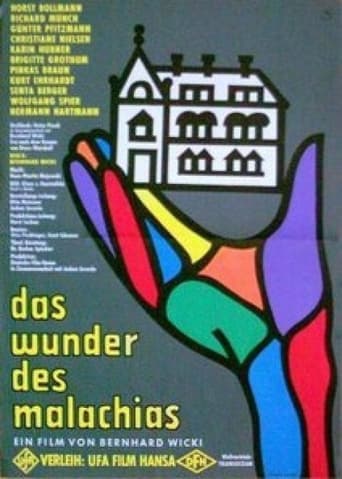
The Miracle of Father Malachia (1961)
Das Wunder des Malachias
The ardent prayer of a monk brings about a true miracle in a West German industrial town, which, however, is not understood by the people but only exploited as a lucrative sensation.
- Date of release
- 1961-07-03
- TMDB
- 5.4 / 10 (10)
- Runtime
- 2h 2m
- Genres
- Comedy
- Director
- Bernhard Wicki
Casting
- Horst Bollmann — Pater Malachias
- Richard Münch — Dr. Erwin Glass
- Christiane Nielsen — Helga Glass
- Günter Pfitzmann — Rudolf Reuschel
- Brigitte Grothum — Gussy
- Karin Hübner — Nelly Moorbach
- Pinkas Braun — Christian Krüger
- Kurt Ehrhardt — Bishop Willi Reuschel
- Kurt Lauermann
- Günter Strack — Kaplan Merz
- Ludwig Thiesen
- Romuald Pekny — Legat
Interesting facts
- Awards: 0 · Nominations: 1
The Miracle of Father Malachia is a 1961 West German black-and-white film directed by Bernhard Wicki and starring Horst Bollmann. The film is based on Bruce Marshall's 1931 novel Father Malachy's Miracle and tells the story of a supposed miracle in a West German town that is soon exploited and sensationalized by the media and profiteers. The film won several awards and was the official West German submission to the 34th Academy Awards for Best Foreign Language Film.
Production
Wicki based his film on the 1938 novel Father Malachy's Miracle by the Scottish accountant and writer Bruce Marshall. He wrote the script together with the screenwriter Heinz Pauck, planning to not only adapt the original novel, but also to expose the "social structure of our saturated [society]" (German: "soziale Struktur unserer Sattheit"). Writing the script took more than six months, whereas the actual filming took five months.
For the main role of Father Malachias Wicki cast the stage actor Horst Bollmann, who had never played in a film. Other important roles were played by experienced film actors such as Richard Münch or Günter Pfitzmann. Supporting actors were often lay actors who played a role corresponding to their real profession, as for example journalists, press photographers or businessmen.
The film was shot completely on location and not a single scene was shot on a studio set. Most scenes were shot in Gelsenkirchen in the Ruhr Area. In total 95 different locations were used, including several industrial sites and the Musiktheater im Revier. A small part of the footage showing monks and priests was shot in advance at the Eucharistical World Congress in Munich.
The film was planned to have its premiere at the International Film Festival in Berlin. As it was not yet completed the selection committee of the film festival saw only a raw cut of the film. This led to speculation in the tabloid press of a race against time and that Wicki had collapsed at the cutting table due to the time pressure. Ultimately the film was finished only seven hours before it premiered at the festival.
Read on Wikipedia · Text from Wikipedia, CC BY-SA 4.0. Data from Wikidata.
Recommended
- 29th Street 1991 · ★ 6.9
- My Best Friend, His Girlfriend and Me 2026 · ★ 6.3
- A Bad Moms Christmas 2017 · ★ 6.3
- Babes 2024 · ★ 6.0
- Beverly Hills Chihuahua 2 2011 · ★ 5.9
- Easy Money 1983 · ★ 6.0
- Thunderstruck 2012 · ★ 6.2
- One Night at McCool's 2001 · ★ 5.9
- The Awakening of Motti Wolkenbruch 2018 · ★ 6.0
- Fun with Dick and Jane 1977 · ★ 6.6
- The Willoughbys 2020 · ★ 7.1
- Scooby-Doo! The Sword and the Scoob 2021 · ★ 7.5