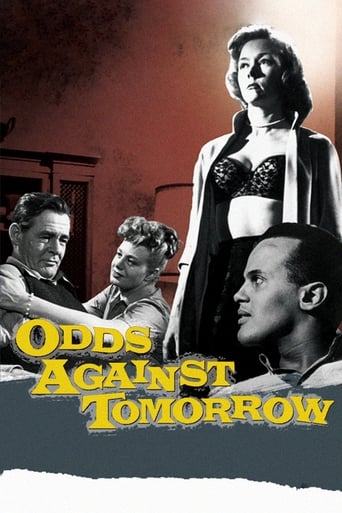
Odds Against Tomorrow (1959)
He knew where $50,000 lay begging to be STOLEN!
An old-time crook plans a heist. When one of his two partners is found out to be a black man tensions flare.
- Date of release
- 1959-10-15
- TMDB
- 6.9 / 10 (100)
- Runtime
- 1h 36m
- Genres
- Crime, Drama, Thriller
- Director
- Robert Wise
Casting
- Robert Ryan — Earle Slater
- Harry Belafonte — Johnny Ingram
- Ed Begley — Dave Burke
- Shelley Winters — Lorry
- Gloria Grahame — Helen
- Will Kuluva — Bacco
- Kim Hamilton — Ruth Ingram
- Mae Barnes — Annie
- Richard Bright — Coco
- Carmen De Lavallade — Kittie
- Lew Gallo — Moriarty
- Lois Thorne — Edie Ingram
Interesting facts
- Awards: 0 · Nominations: 1
Odds Against Tomorrow is a 1959 American film noir produced and directed by Robert Wise and starring Harry Belafonte, Robert Ryan and Ed Begley. Belafonte selected Abraham Polonsky to write the script, which is based on a novel of the same name by William P. McGivern. Blacklisted in those years, Polonsky had to use a front and John O. Killens was credited. Polonsky's screenwriting credit was restored in 1996 in his own name.
Production
The film was produced by HarBel Productions, a company founded by the film's star, Harry Belafonte. He selected Abraham Polonsky as the screenwriter. Polonsky was blacklisted by the House Unamerican Activities Committee at the time, which had conducted extensive hearings on communist influence in the film industry. He used John O. Killens, a black novelist and friend of Belafonte, as a front to be the credited screenwriter.
Principal photography began in March 1959. All outdoor scenes were shot in New York City and Hudson, New York. According to director Robert Wise:
I did something in Odds Against Tomorrow I'd been wanting to do in some pictures but hadn't had the chance. I wanted a certain kind of mood in some sequences, such as the opening when Robert Ryan is walking down West Side Street...I used infra-red film. You have to be very careful with that because it turns green things white, and you can't get too close on people's faces.
This film was the last in which Wise shot black-and-white film in the standard aspect ratio. This technique "gave his films the gritty realism they were known for." After this film, Wise shot two black-and-white films, both in the cinemascope (2.35:1) aspect ratio: Two for the Seesaw and The Haunting.
Read on Wikipedia · Text from Wikipedia, CC BY-SA 4.0. Data from Wikidata.
Recommended
- The Newton Boys 1998 · ★ 6.1
- Little Caesar 1931 · ★ 6.9
- The Wrong Man 1956 · ★ 7.1
- The Night of the Hunter 1955 · ★ 7.9
- Robbery 1967 · ★ 6.6
- Riot in Cell Block 11 1954 · ★ 7.1
- Brute Force 1947 · ★ 7.3
- The Outfit 1973 · ★ 6.8
- Family Plot 1976 · ★ 6.8
- The Outsiders 1983 · ★ 7.2
- The Big Steal 1949 · ★ 6.6
- Winged Creatures 2009 · ★ 5.9