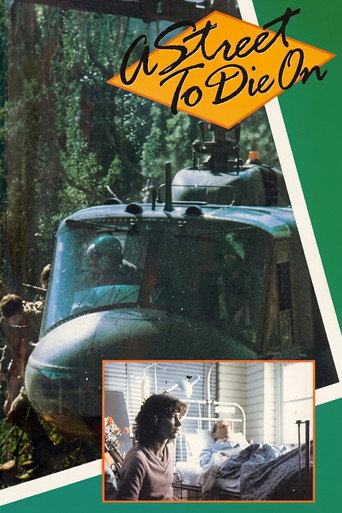
A Street to Die (1985)
An Australian who has fought in Vietnam blames Agent Orange for his cancer, and sues for compensation.
- Date of release
- 1985-10-03
- TMDB
- 6.8 / 10 (4)
- Runtime
- 1h 31m
- Genres
- Drama
- Director
- Bill Bennett
Casting
- Chris Haywood — Col Turner
- Jennifer Cluff — Lorraine Turner
- Arianthe Galani — Dr. Walsea
- Robin Ramsay — Tom
- Peter Hehir — Peter Townley
- Peter Kowitz — Craig
- Pat Evison — Sister Sweet
- Andrew Chirgwin — Paul Turner
- Peter Chirgwin — Jason Turner
- Malcolm Keith — Real Estate Boss
- Susannah Fowle — Julie
- Marion Chirgwin — Kathy
Interesting facts
- Awards: 2 · Nominations: 4. Including: AACTA Award for Best Actor in a Leading Role; Crystal Globe
A Street to Die is a 1985 Australian film directed by Bill Bennett and starring Chris Haywood, Jennifer Cluff, Arianthe Galani. It was nominated for four Australian Film Institute Awards; Haywood won the award for Best Actor in a Lead Role. At the Karlovy Vary International Film Festival, Bennett won a Crystal Globe. The film was based on a true story.
Production
The film was based on the story of Colin Simpson, a Vietnam veteran who had died while trying to claim money from the Repatriation Department. He believed his illness was caused by Agent Orange. Simpson lived in a street in Whalen, a suburb in Western Sydney, where a number of people had health issues. All the sufferers were Vietnam veterans or children of Vietnam veterans brought together on the street by the Housing Commission.
Bill Bennett read about the story in a 1981 article in the Weekend Australian while working as a TV documentary maker. Bennett recalled "I was astonished by this story and was expecting a series of follow-ups, but I looked through all the papers and there were no follow-ups at all. I thought, `This is crazy. This is a great story and it should be out there'.
He pitched it to Peter Luck to be made for The Australians but Luck declined. Bennett then decided to turn it into a dramatic feature. He raised the money himself, focusing on private investors north of Mackay in Queensland, because he heard sugar farmers had done well that year with sugar prices. He eventually raised $350,000.
The script was heavily based on fact - Bennett says it was hardly fictionalised at all. Colin Simpson's widow was heavily involved in the research and writing. "She gave her stamp of approval before we went into production, so it was pretty accurate," said Bennett.
Bennett says he did not really consider the movie an anti-war statement:
Read on Wikipedia · Text from Wikipedia, CC BY-SA 4.0. Data from Wikidata.
Recommended
- Mexicali 2026 · ★ 7.7
- Bennett's War 2019 · ★ 6.7
- Hardball 2001 · ★ 6.5
- Adam 2020 · ★ 6.3
- Sergio 2020 · ★ 6.5
- The Safety of Objects 2002 · ★ 6.5
- Little Boy Blue 1998 · ★ 6.0
- The House on Carroll Street 1988 · ★ 6.0
- My Neighbor Adolf 2022 · ★ 6.6
- The Cut 2025 · ★ 5.9
- That Evening Sun 2009 · ★ 6.8
- Hounddog 2008 · ★ 6.5