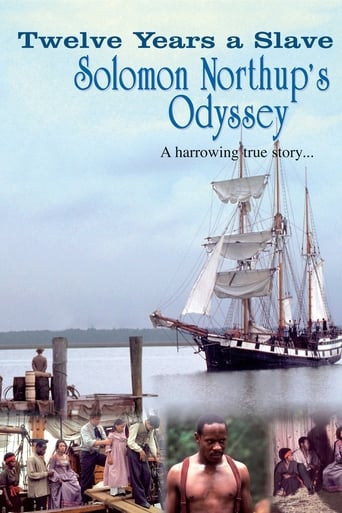
Solomon Northup's Odyssey (1991)
A free Black man from New York is tricked, kidnapped, and sold into slavery in the South, where he endures twelve years of brutal servitude before finding a way to contact his family and secure his freedom.
- Date of release
- 1991-09-21
- TMDB
- 6.8 / 10 (6)
- Runtime
- 1h 55m
- Genres
- TV Movie, Drama
- Director
- Gordon Parks
Casting
- Avery Brooks — Solomon Northup
- Rhetta Greene — Jenny
- Mason Adams — Ford
- Emory Beasley — Alonzo
- Kent Broadhurst — Bass
- Lee Bryant — Mrs. Epps
- Charles Darden — Robert
- Tony Dreyspool — Senator Soule
- Anthony Edenfield — Ned
- Art Evans — Walton
- J. Don Ferguson — Freeman
- Ralph Flanders — Captain
Interesting facts
- Filmed in: Georgia
Solomon Northup's Odyssey, reissued as Half Slave, Half Free, is a 1984 American television film based on the 1853 autobiography Twelve Years a Slave by Solomon Northup, a free black man who in 1841 was kidnapped and sold into slavery. The film, which aired on PBS, was directed by Gordon Parks with Avery Brooks starring as the titular character. It was the second film to be funded by the National Endowment for the Humanities, following A House Divided: Denmark Vesey's Rebellion in 1982. Parks returned to direct the film after years of absence. He chose to work in the Deep South and to collaborate with a crew of mixed races.
Production
Solomon Northup's Odyssey is directed by Gordon Parks, who also composed the film score with Kermit Moore. The television film is based on the autobiography Twelve Years a Slave by Solomon Northup. Lou Potter and Samm-Art Williams wrote the teleplay for the film. The film was produced by The Fremantle Corporation and Past America Inc.
The National Endowment for the Humanities provided funding for a series of programs related to American history. Producer Shep Morgan received a planning grant from the NEH in 1976 and sought input from historians including Robert B. Toplin who suggested the topic of American slavery. When the miniseries Roots was aired in 1977, the team was forced to argue to some television executives that there was more to say about American slavery.
Gordon Parks was approached to direct the film, and though he was disillusioned by his experience with the release of his 1976 feature film Leadbelly, he anticipated a different experience in television. After not having directed a film in years, he returned to adapt the autobiography. The script mostly followed Northup's autobiography, though Parks had to change some parts.
Parks chose to film in areas of the Deep South where Northup labored in slavery. The director sought to have a crew of mixed races, he said "perhaps to show the Southerners how Blacks and Whites could work together". In his memoir, Parks recalled the mix: Japanese American cinematographer Hiro Narita, a black producer and assistant director, a mostly white crew, and a black costume lady who was assisted by a woman from Hong Kong.
Read on Wikipedia · Text from Wikipedia, CC BY-SA 4.0. Data from Wikidata.
Recommended
- The Adventures of Huck Finn 1993 · ★ 6.2
- The Piano Lesson 2024 · ★ 5.8
- The Defiant Ones 1958 · ★ 7.2
- The Way West 1967 · ★ 6.1
- The Dead Don't Hurt 2024 · ★ 6.5
- The Best of Enemies 2019 · ★ 7.4
- Joseph 1995 · ★ 8.3
- Lord of the Flies 1963 · ★ 6.7
- Planet of the Apes 1968 · ★ 7.7
- Oliver Twist 1948 · ★ 7.6
- Jacob 1994 · ★ 6.7
- To Kill a Mockingbird 1962 · ★ 8.0