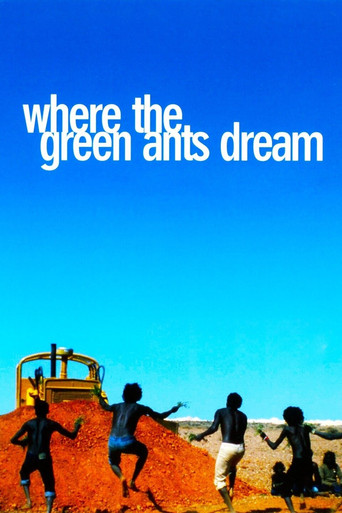
Where the Green Ants Dream (1984)
Wo die grünen Ameisen träumen
The Australian Aborigines (in this film anyway) believe that this is the place where the green ants go to dream, and that if their dreams are disturbed, it will bring down disaster on us all. The Aborigines' belief is not shared by a giant mining company, which wants to tear open the soil and search for uranium.
- Date of release
- 1984-08-31
- TMDB
- 6.8 / 10 (63)
- Runtime
- 1h 40m
- Genres
- Drama
- Director
- Werner Herzog
Casting
- Wandjuk Marika — Miliritbi
- Roy Marika — Dayipu
- Ray Barrett — Cole
- Norman Kaye — Baldwin Ferguson
- Ralph Cotterill — Fletcher
- Bruce Spence — Lance Hackett
- Nico Lathouris — Arnold
- Basil Clarke — Judge Blackburn
- Ray Marshall — Solicitor General Coulthard
- Gary Williams — Watson
- Tony Llewellyn-Jones — Fitzsimmons
- Max Fairchild — Police Officer
Interesting facts
Where the Green Ants Dream is a 1984 English-language West German film directed and co-written by Werner Herzog, made in Australia. Based on a true story about Indigenous land rights in Australia, but slated as a mixture of fact and fiction, it only got a limited release in Australia, where it was not well received by critics; the film fared a bit better in Europe and North America.
Production
Based partly on the Milirrpum v Nabalco Pty Ltd ("Gove land rights") case about Indigenous land rights on the Gove Peninsula in Arnhem Land, Northern Territory, the film is a mix of fact and fiction. The green ant mythology is Herzog's own invention, but some First Nations peoples did consider the green ant to be a totem animal that created the world and humans.
Herzog made use of professional actors, as well as Aboriginal activists from the Northern Territory who were involved in the Milirrpum case and local Aboriginal people from the main filming location, the desert town of Coober Pedy, South Australia. Filming also took place in and near Melbourne, Victoria.
Wandjuk Marika, recommended to Herzog by Phillip Adams, was a leader of the Rirratjingu clan of the Yolngu people, and an artist and musician who was involved in activism for Aboriginal rights. His didgeridoo music is used in the movie, and several members of his family were also cast in the film. The contract with Herzog allowed the Marikas to make enough money to move from Yirrkala to their ancestral region of Yalangbara (aka Port Bradshaw).
Read on Wikipedia · Text from Wikipedia, CC BY-SA 4.0. Data from Wikidata.
Recommended
- Rabbit-Proof Fence 2002 · ★ 7.0
- Man in the Wilderness 1971 · ★ 6.3
- The Spoilers 1942 · ★ 6.2
- Walkabout 1971 · ★ 7.3
- The Proud Rebel 1958 · ★ 6.0
- On the Beach 2000 · ★ 6.2
- Gold 2016 · ★ 6.6
- The 33 2015 · ★ 6.4
- Call Me Crazy: A Five Film 2013 · ★ 7.0
- Rise of the Planet of the Apes 2011 · ★ 7.4
- The Shooting 1966 · ★ 6.3
- The Trial of the Incredible Hulk 1989 · ★ 6.4