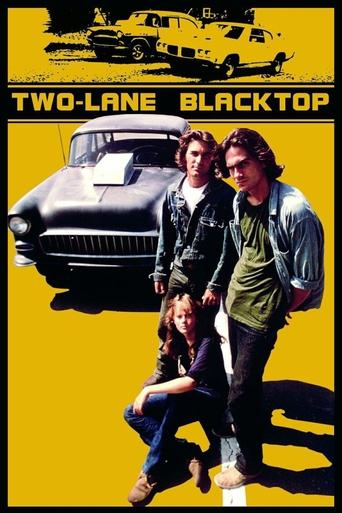
Two-Lane Blacktop (1971)
no beginning... no end... no speed limit...
A driver and mechanic drag racing for money cross paths with a female hitchhiker and a drifter who challenges them to a cross-country race.
- Date of release
- 1971-07-07
- TMDB
- 7.0 / 10 (268)
- Runtime
- 1h 43m
- Genres
- Drama
- Director
- Monte Hellman
Casting
- James Taylor — The Driver
- Warren Oates — G.T.O.
- Dennis Wilson — The Mechanic
- Laurie Bird — The Girl
- Rudy Wurlitzer — Hot Rod Driver
- Harry Dean Stanton — Oklahoma Hitchhiker
- Jaclyn Hellman — Hot Rod Driver's Girl
- Alan Vint — Man in Roadhouse
- Katherine Squire — Old Woman
- Bill Keller — Texas Hitchhiker
- David Drake — Needles Station Attendant
- Richard Ruth — Needles Station Mechanic
Interesting facts
- Budget: $875K
- Filmed in: California, New Mexico, North Carolina and 1 more
Two-Lane Blacktop is a 1971 American road film directed and edited by Monte Hellman, from a screenplay by Rudy Wurlitzer and Will Corry. It stars musicians James Taylor and Dennis Wilson, Warren Oates, and Laurie Bird in the leading roles. The sparse, existentialist plot follows a group of street racers during a cross-country race through the American Southwest.
Production
Two-Lane Blacktop originated with producer Michael Laughlin who had a two-picture deal with CBS Cinema Center Films. He convinced the production company to pay Will Corry $100,000 for his original story, about two men, one black and one white, who drive across the country followed by a young girl, which was inspired by his own cross-country journey in 1968.
In February 1970, Hellman began location scouting and was a few weeks from principal photography when Cinema Center suddenly canceled the project. He shopped the script around to several Hollywood studios that liked it, but wanted a say in the casting. However, Ned Tanen, a young executive at Universal Pictures gave Hellman $850,000 to make the film and gave him control of the final cut.
Four days before beginning principal photography the role of the Mechanic was still not cast. Hellman was desperate and tested people he met in garages. A friend of casting director Fred Roos suggested musician Dennis Wilson. Wilson was the last actor cast and Hellman chose him because he felt that the musician "had lived that role, that he really grew up with cars".
Principal photography began on August 13, 1970, in Los Angeles and lasted for eight weeks with a crew of 30, three matching Chevrolets and two matching G.T.O.s traveling through the southwest towards Memphis, Tennessee. Gregory Sandor shot the entire film, but due to union issues, camera operator Jack Deerson was credited as the director of photography, while Sandor was credited as the film's "photographic advisor".
Hellman shot almost the entire script as written. The first cut of the film was three-and-a-half hours long, in which Hellman was the editor. "I can't look over someone's shoulder. I need my hand on the brake". He had control of the final cut, but was contractually obliged to deliver a film no longer than two hours. The final version ran 105 minutes.
Read on Wikipedia · Text from Wikipedia, CC BY-SA 4.0. Data from Wikidata.
Recommended
- Ford v Ferrari 2019 · ★ 8.0
- Days of Thunder 1990 · ★ 6.4
- Rush 2013 · ★ 7.7
- Need for Speed 2014 · ★ 6.5
- Winning 1969 · ★ 6.0
- Come Sunday 2018 · ★ 5.8
- Gigi & Nate 2022 · ★ 7.6
- How Sarah Got Her Wings 2015 · ★ 5.9
- What Maisie Knew 2013 · ★ 7.1
- My Zoe 2019 · ★ 6.5
- Resurrecting the Champ 2007 · ★ 6.3
- F.I.S.T. 1978 · ★ 6.5