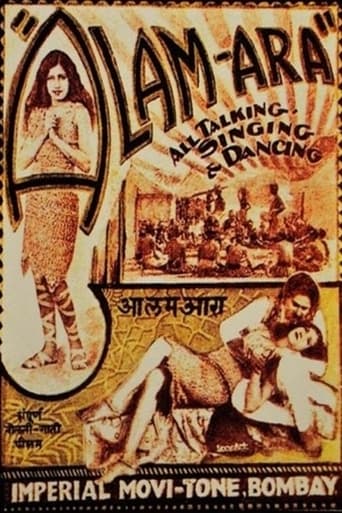
Alam Ara (1931)
आलम आरा
A period fantasy that told of the ageing king of Kamarpur, and his two rival queens, Navbahar and Dilbahar, and their rivalry when a fakir predicts that Navbahar will bear the king's heir. Dilbahar unsuccessfully tries to seduce the army chief Adil (Vithal) and vengefully destroys his family, leaving his daughter Alam Ara (Zubeida) to be raised by nomads. Eventually, Alam Ara's nomad friends invade the palace, expose Dilbahar's schemes, release Adil from the dungeon and she marries the prince of the realm.
- Date of release
- 1931-03-14
- TMDB
- 6.5 / 10 (2)
- Runtime
- 2h 4m
- Genres
- Fantasy
- Director
- Ardeshir Irani
Casting
- Master Vithal — Adil
- Zubeida — Alam Ara
- Jillo
- Sushila
- Prithviraj Kapoor
- Elizer
- Wazir Mohammed Khan
- Jagdish Sethi
- L. V. Prasad
Interesting facts
Alam Ara is a 1931 Indian historical fantasy film directed and produced by Ardeshir Irani. It revolves around a king and his two wives, Navbahaar and Dilbahaar, who are childless; soon, a fakir tells the king that the former wife will give birth to a boy, later named Qamar, but the child will die following his 18th birthday if Navbahaar cannot find the necklace he asks for. Meanwhile, the king finds out that Dilbahaar has fallen for the senapati Adil, leading the king to arrest him and evict his pregnant wife, who later gives birth to Alam Ara (Zubeida).
Production
After watching Harry A. Pollard's 1929 American romantic drama part-talkie Show Boat at Excelsior Theatre in Bombay (present-day Mumbai), Ardeshir Irani was inspired to make his next project a sound film which he would direct and produce. Although having no experience creating this type of film, he determined to make it and decided to not follow any precedential sound films.
Zubeida was cast in the title role after Irani's frequent collaborator and first choice, Ruby Myers, was unable to join the cast due to her inability to speak the film's language. This left Myers disappointed and she took a one-year hiatus from acting, perfecting her ability to speak Hindustani.
Alam Ara, which was funded by the business tycoon Seth Badriprasad Dube, cost ₹40,000 (equivalent to ₹13 million or US$140,000 in 2026). Principal photography was completed by Adi M. Irani at Jyoti Studios in Bombay within four months, using equipment that was bought from Bell & Howell. When being interviewed by Bhagwan Das Garga, Ardeshir Irani confessed that he kept the project a secret during its production. H. M.
Irani and Rustom Bharucha, a lawyer and the manager of his other production company, Imperial Studios, worked as sound technicians for the film. Before the shooting started, they learned the basics of sound recording from American expert Wilford Deming. When Deming came to Mumbai to give them the sound machines, he charged ₹100 (equivalent to ₹33,000 or US$340 in 2026), which Irani considered a large number at the time.
Read on Wikipedia · Text from Wikipedia, CC BY-SA 4.0. Data from Wikidata.
Recommended
- Princess 2008 · ★ 6.2
- Naughty or Nice 2012 · ★ 6.0
- Slumberland 2022 · ★ 7.2
- Anastasia: Once Upon a Time 2020 · ★ 5.9
- Dragonheart: Vengeance 2021 · ★ 6.8
- The Wizards Return: Alex vs. Alex 2013 · ★ 7.8
- The Loud House Movie 2021 · ★ 7.2
- MirrorMask 2005 · ★ 6.4
- The Odd Life of Timothy Green 2012 · ★ 7.0
- Strings 2004 · ★ 6.6
- Scooby-Doo! The Sword and the Scoob 2021 · ★ 7.5
- The Princess and the Goblin 1991 · ★ 5.8