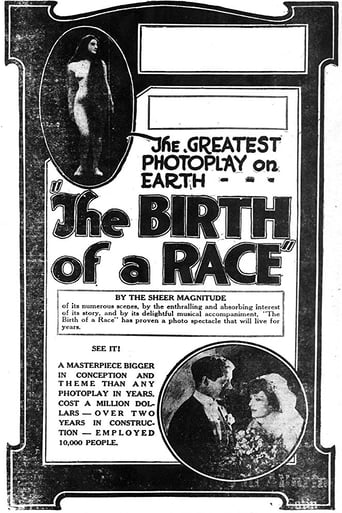
The Birth of a Race (1918)
The Greatest Photoplay on Earth
This epic traces, from the Beginning, the lineage of the race of peace-loving people. Mankind at its best is highlighted as greatness of character across the centuries is displayed: Noah heeding God's command, Moses leading the Israelities, Jesus Christ dying to save humanity and promote His message of peace. Moving into our modern epoch: Columbus's discovery of America, the Declaration of Independence, the Emancipation Proclamation; A race of free humans committed to the proliferation of peace and freedom. What becomes of this race when autocratic powers threaten democracy in the time of the first World War?
- Date of release
- 1918-01-02
- TMDB
- 7.5 / 10 (2)
- Runtime
- 1h 28m
- Genres
- Drama, History, War
- Director
- John W. Noble
Casting
- Louis Dean — The Kaiser
- Harry Dumont — Crown Prince
- Carter B. Harkness — Adam
- Doris Doscher — Eve
- Charles E. Graham — Noah
- Ben Hendricks Sr. — Fritz Schmidt
- Alice Gale — Frau Schmidt
- John Reinhardt — Oscar Schmidt
- Gertrude Braun — Louisa Schmidt
- Stephen Grattan — Pat O'Brien
- Mary Carr — Mrs. O'Brien
- Jane Grey — Jane O'Brien
Interesting facts
- Filmed in: Florida and Chicago
The Birth of a Race is a 1918 American silent drama film directed by John W. Noble. It was made as a response to the 1915 film The Birth of a Nation, and was meant to discredit the negative stereotypes perpetuated by the film. Initially, it was intended to be a short answer film that could be appended to The Birth of a Nation in 1915, but a combination of weak financial backing and growing ambitions delayed its completion for more than two years.
Production
Principal filming took place in Chicago and Tampa, Florida. Several outdoor scenes were filmed in Tampa in January, 1918, including ancient Egypt and the rescue of the infant Moses from a river and Simon of Cyrene helping Jesus carry his cross on the Via Dolorosa.
The original screenplay purportedly demonstrated black achievements throughout history. A brochure pitching the film to potential investors reads:The Birth of a Race, the true story of the Negro — his life in Africa, his enslavement, his freedom, his achievements — together with his past, present and future relations with his white neighbor.
The final film was reportedly 2 hours and 30 minutes in length, but after two public showings it was cut to 60 minutes. The 60-minute short version is preserved at the Library of Congress.
Read on Wikipedia · Text from Wikipedia, CC BY-SA 4.0. Data from Wikidata.
Recommended
- The Last Rifleman 2023 · ★ 6.6
- Field of Lost Shoes 2015 · ★ 6.1
- Walking with the Enemy 2014 · ★ 6.3
- Waiting for Anya 2020 · ★ 6.3
- For Greater Glory: The True Story of Cristiada 2012 · ★ 7.0
- The Scarlet and the Black 1983 · ★ 7.1
- Sometimes in April 2005 · ★ 7.1
- Flyboys 2006 · ★ 6.5
- Overlord 1975 · ★ 6.8
- Tobruk 1967 · ★ 6.4
- Ike: Countdown to D-Day 2004 · ★ 6.5
- The Kill Team 2019 · ★ 6.5