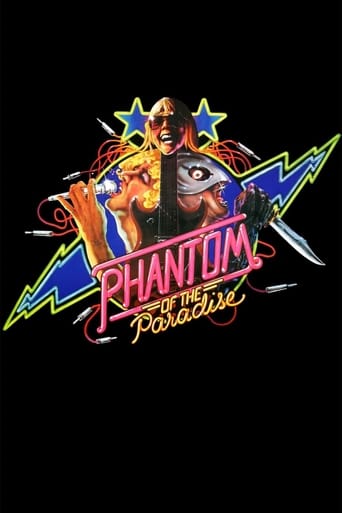
Phantom of the Paradise (1974)
He sold his soul for rock n’ roll!
Singer-songwriter Winslow Leach seeks revenge on the nefarious music producer Swan, who steals both Winslow's music and his favorite singer for the grand opening of Swan's new rock palace, the Paradise.
- Date of release
- 1974-10-31
- TMDB
- 7.5 / 10 (804)
- Runtime
- 1h 32m
- Genres
- Drama, Horror, Music
- Director
- Brian De Palma
Casting
- William Finley — Winslow Leach / The Phantom
- Paul Williams — Swan
- Jessica Harper — Phoenix
- George Memmoli — Philbin
- Gerrit Graham — Beef
- Archie Hahn — The Juicy Fruits / The Beach Bums / The Undeads
- Jeffrey Comanor — The Juicy Fruits / The Beach Bums / The Undeads
- Peter Elbling — The Juicy Fruits / The Beach Bums / The Undeads
- Colin Cameron — Band
- David Garland — Band
- Gary Mallaber — Band
- Art Munson — Band
Interesting facts
- Budget: $1.3M
- Based on: The Phantom of the Opera, The Hunchback of Notre Dame, and Faust
- Awards: 0 · Nominations: 1
Phantom of the Paradise is a 1974 American rock musical comedy horror film written and directed by Brian De Palma, and scored by and starring Paul Williams.
Production
The root for making the film was a recollection that Brian De Palma had hearing a Beatles song in an elevator played as "muzak" to go along with experiences trying to pitch material to indifferent executives and an idea from his friends Mark Stone and John Weiser about a Phantom of the Fillmore. The script was written in tandem with Sisters (1972), although that film was done first because of its perceived commercial viability.
The record press in which William Finley's character Winslow was disfigured was a real injection-molding press at Pressman Toys. Finley was worried about whether the machine would be safe, and the crew assured that it was. The press was fitted with foam pads (which resemble the casting molds in the press), and there were chocks put in the center to stop it from closing completely.
The electronic room in which Winslow composes his cantata, and where Swan restores his voice, is in fact the real-life recording studio The Record Plant. The walls covered with knobs are in reality an oversize custom-built electronic synthesizer dubbed TONTO. The City Center concert hall in New York City provided the exterior for The Paradise; interior concert scenes were filmed at the Majestic Theater in Dallas, Texas.
Sissy Spacek was the film's set dresser, assisting Jack Fisk, the film's production designer, whom she later married. She later starred in De Palma's Carrie in 1976. The film was financed independently. Producer Edward R. Pressman then screened the movie to studios and sold it to 20th Century Fox for $2 million plus a percentage.
Read on Wikipedia · Text from Wikipedia, CC BY-SA 4.0. Data from Wikidata.
Recommended
- Repo! The Genetic Opera 2008 · ★ 6.3
- Crossroads 1986 · ★ 7.4
- Taurus 2022 · ★ 5.8
- The Devil's Advocate 1997 · ★ 7.5
- Trick or Treat 1986 · ★ 6.1
- American Satan 2017 · ★ 7.1
- Better Man 2024 · ★ 7.6
- Sweeney Todd: The Demon Barber of Fleet Street 2007 · ★ 7.2
- The Perfection 2018 · ★ 6.4
- National Theatre Live: Frankenstein 2011 · ★ 7.7
- Jailhouse Rock 1957 · ★ 6.3
- Pink Floyd: The Wall 1982 · ★ 8.0