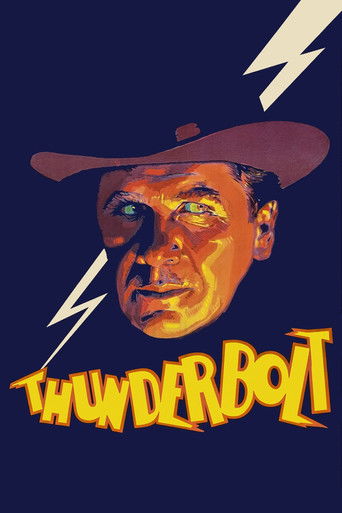
Thunderbolt (1929)
A criminal known as Thunderbolt is imprisoned and facing execution. Into the next cell is placed Bob Moran, an innocent man who has been framed and who is in love with Thunderbolt's girl, without knowing of their relationship. Thunderbolt hopes to stave off the execution long enough to kill young Moran for romancing his girl.
- 公開日
- 1929-06-20
- TMDB
- 5.7 / 10 (33)
- 上映時間(分)
- 1時間31分
- ジャンル
- 犯罪, ドラマ
- 監督
- Josef von Sternberg
キャスト
- George Bancroft — Thunderbolt Jim Lang
- Fay Wray — Ritzy
- Richard Arlen — Bob Moran
- Tully Marshall — Warden
- Eugenie Besserer — Mrs. Moran
- James Spottswood — 'Snapper' O'Shea
- Fred Kohler — 'Bad Al' Friedberg
- Robert Elliott — Prison chaplain
- E.H. Calvert — Dist. Atty. McKay
- George Irving — Mr. Corwin
- Mike Donlin — Kentucky Sampson
- S.S. Stewart — Convict
豆知識
- 受賞:0 · ノミネート:1
Thunderbolt is a 1929 American pre-Code proto-noir film directed by Josef von Sternberg and starring George Bancroft, Fay Wray, Richard Arlen, Tully Marshall and Eugenie Besserer. It tells the story of a criminal, facing execution, who wants to kill the man in the next cell for being in love with his former girlfriend.
Production
Thunderbolt was Sternberg’s first film using synchronized sound technology. Two versions of the film were produced, including a silent version for theatres that had yet to be adapted to sound.
The technical innovation of synchronized dialogue in the film raised concerns among directors as to its potential influence on the visual techniques available to directors. Internationally, filmmakers such as Sergei Eisenstein, Vsevolod Pudovkin, Alfred Hitchcock, and Dziga Vertov wished to avoid oppressive forms of ”theatrically-influenced dialogue” even as audiences clamored for the novelty of naturalistic speech.
Sternberg welcomed sound as a means to achieve complete control over his picture - "no longer at the mercy of movie house organists" - and eschewing any "atmospheric" or background music. Thunderbolt (as well as his next three sound films) used source music that arose directly from the mise en scène.
Sternberg experimented with asynchronous sound effects which served to augment or supplement the visual effects, or as he framed the process, “To be correctly and effectively used, the sound had to bring to the image a quality other than what the lens included, a quality out of the range of the image.
The music off-screen does not recede in deference to the on-screen dialogue, but competes with it. Off-screen, voices comment on the visual action, but are not identified visually until later in the film sequence, contributing to an “unrealistic cadence” that characterizes the film’s dialogue. Film historian Andrew Sarris describes it as "a startling experiment...
Wikipediaで続きを読む · テキストはWikipedia、CC BY-SA 4.0。データはWikidata。
おすすめ
- Plunder Road 1957 · ★ 6.9
- 夕暮れのとき 1956 · ★ 6.9
- 5 Against the House 1955 · ★ 5.9
- ブルー・ガーディニア 1953 · ★ 6.5
- 裸の町 1948 · ★ 7.2
- Sleep, My Love 1948 · ★ 6.3
- 非情の時 1957 · ★ 6.5
- ナンシー・ドリューと秘密の階段 2019 · ★ 6.3
- 私は逃亡者 1947 · ★ 6.6
- House of Bamboo 1955 · ★ 6.2
- 我れ暁に死す 1939 · ★ 6.9
- 危険な女 1946 · ★ 6.3