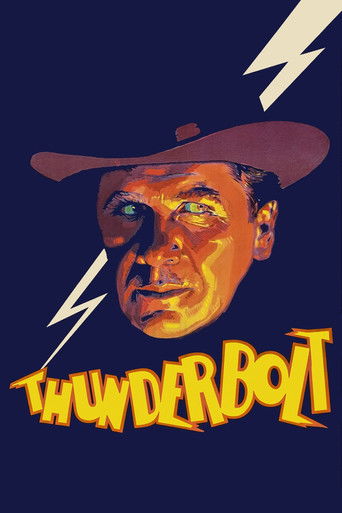
霹雳 (1929)
Thunderbolt
乔治·班克罗夫特以斗牛犬般的决心示爱!费伊·雷是他的陪衬,而理查德·阿伦则是他的情敌。
一个名叫霹雳的罪犯被监禁并面临处决。下一间牢房里被关进去的是鲍勃·摩根,一个被陷害的无辜男子,他爱上了霹雳的女友,却不知道他们的关系。霹雳希望能够延迟处决的时间,足够他杀死年轻的摩根,因为他和他的女孩有染。
演员阵容
- George Bancroft — Thunderbolt Jim Lang
- Fay Wray — Ritzy
- Richard Arlen — Bob Moran
- Tully Marshall — Warden
- Eugenie Besserer — Mrs. Moran
- James Spottswood — 'Snapper' O'Shea
- Fred Kohler — 'Bad Al' Friedberg
- Robert Elliott — Prison chaplain
- E.H. Calvert — Dist. Atty. McKay
- George Irving — Mr. Corwin
- Mike Donlin — Kentucky Sampson
- S.S. Stewart — Convict
趣闻
- 获奖:0 · 提名:1
Thunderbolt is a 1929 American pre-Code proto-noir film directed by Josef von Sternberg and starring George Bancroft, Fay Wray, Richard Arlen, Tully Marshall and Eugenie Besserer. It tells the story of a criminal, facing execution, who wants to kill the man in the next cell for being in love with his former girlfriend.
Production
Thunderbolt was Sternberg’s first film using synchronized sound technology. Two versions of the film were produced, including a silent version for theatres that had yet to be adapted to sound.
The technical innovation of synchronized dialogue in the film raised concerns among directors as to its potential influence on the visual techniques available to directors. Internationally, filmmakers such as Sergei Eisenstein, Vsevolod Pudovkin, Alfred Hitchcock, and Dziga Vertov wished to avoid oppressive forms of ”theatrically-influenced dialogue” even as audiences clamored for the novelty of naturalistic speech.
Sternberg welcomed sound as a means to achieve complete control over his picture - "no longer at the mercy of movie house organists" - and eschewing any "atmospheric" or background music. Thunderbolt (as well as his next three sound films) used source music that arose directly from the mise en scène.
Sternberg experimented with asynchronous sound effects which served to augment or supplement the visual effects, or as he framed the process, “To be correctly and effectively used, the sound had to bring to the image a quality other than what the lens included, a quality out of the range of the image.
The music off-screen does not recede in deference to the on-screen dialogue, but competes with it. Off-screen, voices comment on the visual action, but are not identified visually until later in the film sequence, contributing to an “unrealistic cadence” that characterizes the film’s dialogue. Film historian Andrew Sarris describes it as "a startling experiment...
在维基百科阅读更多 · 文本来自维基百科,CC BY-SA 4.0。数据来自 Wikidata。