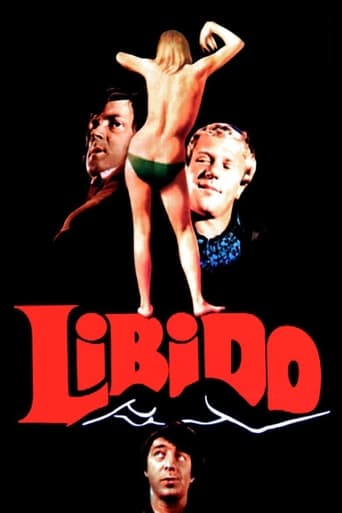
Libido (1973)
A film quartet about the erotic drive within us all
Scripted by four of Australia’s greatest authors (David Williamson, Thomas Keneally, Hal Porter and Craig McGregor), this quartet of carnal desires explores adultery and jealous fantasies, the end of innocence, the moral and spiritual conflicts of a priest and a nun in love. The stories define the exploration of women and the cultural upheaval of the early 70s.
- Date of release
- 1973-04-06
- TMDB
- 4.7 / 10 (6)
- Runtime
- 1h 57m
- Genres
- Drama
- Director
- Tim Burstall, John B. Murray, Fred Schepisi, David Baker
Casting
- Elke Neidhart — Penelope (segment "The Husband")
- Bryon Williams — Jonathon (segment "The Husband")
- Mark Albiston — Harold (segment "The Husband")
- Jill Forster — Mother (segment "The Child")
- Judy Morris — Sybil (segment "The Child")
- Bruce Barry — David (segment "The Child")
- Louise Homfrey — Housekeeper (segment "The Child")
- Vivean Gray — Elderly Nun (segment "The Priest")
- Arthur Dignam
- Robyn Nevin
- Judy Morris
- Penne Hackforth-Jones
Interesting facts
Libido is a 1973 Australian drama film comprising 4 segments written and directed as independent stories, but screened together as one piece, exploring a common theme of instinctive desire and contemporary sexuality.
Production
The film arose from a series of workshops held in 1971 by the Victorian Branch of the Producers and Directors Guild to help writers work in narrative cinema. Professional writers were invited to prepare short stories on the theme of love which were adapted and produced by members of the Guild. Four of them were linked in the film.
Tim Burstall wanted to direct the David Williamson segment but because he had worked with Williamson before was given the Hal Porter one, originally called The Jetty. Burstall made some key changes to the story to make it more autobiographical and work better for film. It was shot at Werribee Park Estate in June 1972.
All the stories were shot and filmed in and around Melbourne on 16mm for a budget of $100,000, including $26,000 from the Australian Council for the Arts. According to Burstall, the episodes directed by Murray, Baker and Schepisi cost about $7,000 each and his cost $13,000 - although he says the true cost, accounting for deferrals, was closer to $23,000. He says the total cost of shooting the film was $75,000 being $120,000 after deferrals.
British Empire Films later added some funds to enable the film to be blown up to 35mm (some sources say $20,000 others $36,000).
Read on Wikipedia · Text from Wikipedia, CC BY-SA 4.0. Data from Wikidata.
Recommended
- The Ledge 2011 · ★ 6.2
- Addicted 2014 · ★ 5.9
- Crash 1996 · ★ 6.5
- Agora 2009 · ★ 7.0
- Adulterers 2016 · ★ 6.2
- Dream Lover 1994 · ★ 6.8
- American Beauty 1999 · ★ 8.0
- Faces 1968 · ★ 7.1
- The Last Temptation of Christ 1988 · ★ 7.2
- Rogue Agent 2022 · ★ 6.3
- The Brutalist 2024 · ★ 6.9
- Heatwave 2022 · ★ 6.2