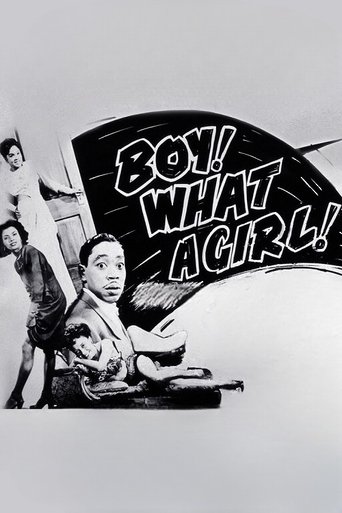
Boy! What a Girl! (1947)
Two silky-smooth producers line up a potential backer (who'll put up half the cash) for a musical review. The catch is that they must find someone else to put up the other half. Enter cigar-smoking cross-dresser "Bumpsie" (Tim Moore), who poses as a wealthy society matron to fool the angel! Features vintage jam sessions with swing drummer Gene Krupa, Big Sid Catlett and his band, The Slam Stewart Trio and The International Jitterbugs.
- Date of release
- 1947-04-07
- TMDB
- 3.8 / 10 (4)
- Runtime
- 1h 10m
- Genres
- Music
- Director
- Arthur H. Leonard
Casting
- Sheila Guyse — Francine Cummings
- Tim Moore — Bumpsie
- Elwood Smith — Jim Walton
- Duke Williams — Harry Diggs
- Alan Jackson — Mr. Cummings
- Betti Mays — Cristola Cummings
- Sybil Lewis — Mme. Deborah Martin
- Warren Patterson — Donaldson (the landlord)
- Slam Stewart — Slam
- Deek Watson — himself
- Sidney Catlett — himself
- Ann Cornell — herself
Interesting facts
- Filmed in: Sony Music Studios
Boy! What a Girl! is a 1947 American race film directed by Arthur H. Leonard and starring Tim Moore, with guest appearances by the Brown Dots, Slam Stewart, Sid Catlett and Gene Krupa.
Production
Boy! What a Girl! was planned to be the first in a series of all-black race films produced by the independent company Herald Pictures. The film’s press kit acknowledged the segregated distribution patterns of the race film by proclaiming Boy! What a Girl! would be “an all-Negro motion picture can be produced to play in any theater in the country and not merely confined to the some 600 odd playhouses that cater strictly to an all-Negro audience.”
The film was shot at the Fox Movietone Studio in New York City. Gene Krupa, the only white member of the cast, was not originally signed to appear in the film; director Arthur H. Leonard invited Krupa to be on camera when the famous drummer stopped by to visit cast member Sid Catlett on the set.
Boy! What a Girl! was the only starring film role for Tim Moore, an African American vaudeville comedy star who later became famous as the Kingfish in the television series Amos 'n Andy.
A pre-production news item identified Marva Lewis, the ex-wife of boxing champion Joe Louis, as being a part of the cast, but she is not present in the finished film, as she was forced to withdraw due to illness. She was replaced by the Brown Dots.
Read on Wikipedia · Text from Wikipedia, CC BY-SA 4.0. Data from Wikidata.
Recommended
- Hit Man Returns - David Foster & Friends 2011 · ★ 6.6
- Make Your Move 2013 · ★ 5.8
- Michael Jackson Video Greatest Hits: HIStory 1995 · ★ 8.3
- King of Jazz 1930 · ★ 6.5
- I Am Easy to Find 2019 · ★ 7.1
- Apple Music Live: Lady Gaga MAYHEM Requiem 2026 · ★ 8.3
- Teen Spirit 2019 · ★ 6.0
- Shakira In Concert: El Dorado World Tour 2019 · ★ 8.4
- The Big Store 1941 · ★ 6.3
- Honeydripper 2007 · ★ 5.9
- Jesus Christ Superstar - Live Arena Tour 2012 · ★ 7.3
- Too Late Blues 1961 · ★ 6.4