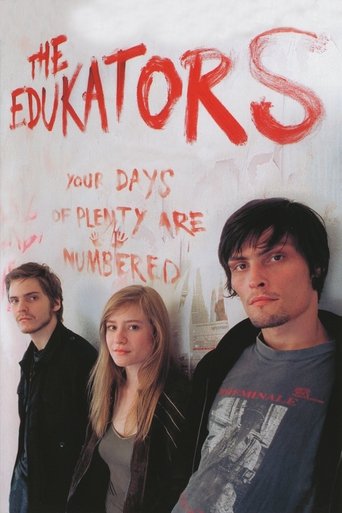
The Edukators (2004)
Die fetten Jahre sind vorbei
Every heart is a revolutionary cell.
Three activists cobble together a kidnapping plot after they encounter a businessman in his home.
- Date of release
- 2004-10-25
- TMDB
- 7.2 / 10 (397)
- Runtime
- 2h 7m
- Genres
- Drama, Comedy
- Director
- Hans Weingartner
Casting
- Daniel Brühl — Jan
- Julia Jentsch — Jule
- Stipe Erceg — Peter
- Burghart Klaußner — Justus Hardenberg
- Peer Martiny — Villenbesitzer
- Petra Zieser — Villenbesitzerin
- Laura Schmidt — Tochter
- Sebastian Butz — Sohn
- Oliver Bröcker — Globalisierungsgegner
- Hanns Zischler — Vermieter
- Claudio Caiolo — Paolo
- Bernhard Bettermann — Jules Chef
Interesting facts
- Filmed in: Berlin and Austria
- Awards: 1 · Nominations: 1. Including: German Film Award for Best Feature Film
The Edukators is a 2004 crime drama film directed by the Austrian director Hans Weingartner. A co-production between Germany and Austria, it stars Daniel Brühl, Stipe Erceg, and Julia Jentsch as three young, anti-capitalist Berlin activists involved in a love triangle. The friends, calling themselves "the Edukators", invade upper-class houses, rearrange the furniture, and leave notes identifying themselves. Weingartner, a former activist, wrote the film based on his experiences and chose to use nonviolent characters. The film, shot in Berlin and Austria with digital hand-held cameras, was made on a low budget which Weingartner said kept the focus on the acting.
Production
According to Weingartner, The Edukators was influenced by his past as a political activist: "There's some of me in the film". He considers it an autobiographical film, with Brühl playing Weingartner. It describes the last 10 years of his life, an attempt to find a political movement satisfying his ideals. It also reflects his frustration over the lack of political ideals among his generation and the effect of advertising and media images.
The director opted for nonviolence because violence "only makes the system stronger", citing the Baader-Meinhof gang which "practically killed the Left movement in Germany ... because they gave the police an excuse to really arm up and create a more totalitarian system." Instead, Weingartner gave his characters "poetic resistance."
Although Brühl thought the film "very realistic", he was dissatisfied with his character's authenticity. The actor felt "attached" to Jan, admiring his "courage to want to change the way things are going, to act to defend his beliefs", but thought it was "very utopian and naive, that they take so much risk to break into some rich man's house to move things around."
The authenticity of the love triangle was "very important" to Weingartner, who was once part of such a relationship. Although the actors were uncertain at first that Peter could forgive Jan and Jule's betrayal, Weingartner uses the situation to explore his concept of friendship: "Friendship means more to him than bourgeois moral values. Peter loves Jule – he doesn't own her.
Weingartner said he received an offer large enough that "I would not have to work for the rest of my life" from an American studio but refused it, opting to produce the film with his own studio, y3film, and coop99, an Austrian studio. A low-budget film, it was funded by a €250,000 loan Weingartner obtained with his parents' house as collateral.
Read on Wikipedia · Text from Wikipedia, CC BY-SA 4.0. Data from Wikidata.
Recommended
- Panic Room 2002 · ★ 6.8
- Cleveland Abduction 2015 · ★ 7.3
- The Disappearance of Alice Creed 2009 · ★ 6.5
- Gringo 2018 · ★ 5.9
- Night Always Comes 2025 · ★ 6.1
- Ruthless People 1986 · ★ 6.6
- Suicide Kings 1997 · ★ 6.6
- Dogville 2003 · ★ 7.7
- Dead Man's Wire 2026 · ★ 6.5
- Restraint 2008 · ★ 5.9
- The Place Beyond the Pines 2013 · ★ 7.0
- Animals 2026 · ★ 7.0