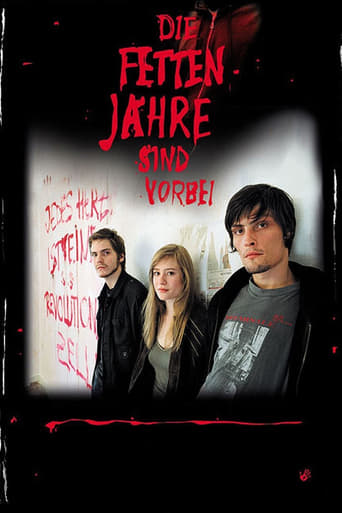
替天行道三人行 (2004)
Die fetten Jahre sind vorbei
故事发生在德国当代,简(丹尼尔·布鲁赫 Daniel Brühl 饰),皮特(斯坦奇·艾塞克 Stipe Erceg 饰)和朱莉(朱丽娅·耶恩奇 Julia Jentsch 饰)是三个社会上随处可见的普通青年。但在他们的内心里,愤怒和失望的火焰从未停止过燃烧,对于国家的现状,对于政府的不满,对于富人的仇恨,为了给这些汹涌的感情找到出口,他们必须要做一些与众不同的事情。
- 上映日期
- 2004-10-25
- TMDB
- 7.2 / 10 (400)
- 片长(分钟)
- 2小时7分钟
- 类型
- 剧情, 喜剧
- 导演
- Hans Weingartner
演员阵容
- 丹尼尔·布鲁赫 — Jan
- 茱莉亚·詹奇 — Jule
- Stipe Erceg — Peter
- 布尔格哈特·克劳斯纳 — Justus Hardenberg
- Peer Martiny — Villenbesitzer
- Petra Zieser — Villenbesitzerin
- Laura Schmidt — Tochter
- Sebastian Butz — Sohn
- Oliver Bröcker — Globalisierungsgegner
- 汉斯·齐施勒 — Vermieter
- Claudio Caiolo — Paolo
- 伯恩哈德·贝特曼 — Jules Chef
趣闻
- 拍摄地:柏林和奧地利
- 获奖:1 · 提名:1. 包括:德國電影獎最佳影片獎
The Edukators is a 2004 crime drama film directed by the Austrian director Hans Weingartner. A co-production between Germany and Austria, it stars Daniel Brühl, Stipe Erceg, and Julia Jentsch as three young, anti-capitalist Berlin activists involved in a love triangle. The friends, calling themselves "the Edukators", invade upper-class houses, rearrange the furniture, and leave notes identifying themselves. Weingartner, a former activist, wrote the film based on his experiences and chose to use nonviolent characters. The film, shot in Berlin and Austria with digital hand-held cameras, was made on a low budget which Weingartner said kept the focus on the acting.
Production
According to Weingartner, The Edukators was influenced by his past as a political activist: "There's some of me in the film". He considers it an autobiographical film, with Brühl playing Weingartner. It describes the last 10 years of his life, an attempt to find a political movement satisfying his ideals. It also reflects his frustration over the lack of political ideals among his generation and the effect of advertising and media images.
The director opted for nonviolence because violence "only makes the system stronger", citing the Baader-Meinhof gang which "practically killed the Left movement in Germany ... because they gave the police an excuse to really arm up and create a more totalitarian system." Instead, Weingartner gave his characters "poetic resistance."
Although Brühl thought the film "very realistic", he was dissatisfied with his character's authenticity. The actor felt "attached" to Jan, admiring his "courage to want to change the way things are going, to act to defend his beliefs", but thought it was "very utopian and naive, that they take so much risk to break into some rich man's house to move things around."
The authenticity of the love triangle was "very important" to Weingartner, who was once part of such a relationship. Although the actors were uncertain at first that Peter could forgive Jan and Jule's betrayal, Weingartner uses the situation to explore his concept of friendship: "Friendship means more to him than bourgeois moral values. Peter loves Jule – he doesn't own her.
Weingartner said he received an offer large enough that "I would not have to work for the rest of my life" from an American studio but refused it, opting to produce the film with his own studio, y3film, and coop99, an Austrian studio. A low-budget film, it was funded by a €250,000 loan Weingartner obtained with his parents' house as collateral.
在维基百科阅读更多 · 文本来自维基百科,CC BY-SA 4.0。数据来自 Wikidata。