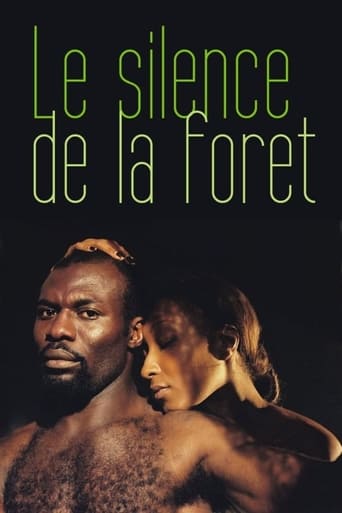
Le silence de la forêt (2003)
A film about the difficulty for even the most well-intentioned person to know and respect another culture. In this case, the problem is so acute that there is even heated debate over what to call that 'other.' The subtitles in the film use the familiar word 'pygmies,' a relatively pejorative European term; the Bantu or villagers' expression for the same group, Babingas, carries similar negative connotations. These highly specialized, tropical rainforest hunter-gatherers should perhaps be called by their own ethnonym, Aka, MoAka (sing.) and BaAka (pl.)
- Data di uscita
- 2003-05-19
- TMDB
- 6.3 / 10 (3)
- Durata
- 1 h 33 min
- Generi
- Dramma, Avventura
- Regista
- Didier Ouénangaré, Bassek Ba Kobhio
Cast
- Ériq Ebouaney — Gonaba
- Nadège Beausson-Diagne — Simone
- Sonia Zembourou — Kali
- Philippe Mory — The Prefect
Curiosità
Le silence de la forêt is a 2003 drama film directed by Bassek Ba Kobhio and Didier Ouenangare. The film is an adaption of the eponymous novel by Étienne Goyémidé. A co-production between Gabon, Cameroon, the Central African Republic, and France, it is the first feature filmed in the Central African Republic. It is also the first film to depict the contemporary prejudice held by some Africans toward the pygmy people.
Production
The film was initially to be directed by the Central African Republic-based filmmaker Didier Ouenangare in his directorial debut. When Cameroonian director Bassek Ba Kobhio joined the project as lead director, Ouenangare took on the role of co-director. The film was filmed in CAR during a time of economic crisis and a military coup in 2003.
The Forest was funded by Cameroon, Gabon, and France, the former providing a grant of 50000 FF from the Agence intergouvernmentale de la francophonie.
Most of the cast members and crew were recruited from CAR neighbouring nations including Cameroon and Gabon, which prompted criticism aimed at Ouenangare for not selecting Central Africans. Cameroonian actor Eriq Ebouaney was brought on to play the lead role and had to learn Sango, one of the official languages of Central African Republic. Cameroonian veteran music composer Manu Dibango scored the music for the film.
Leggi su Wikipedia · Testo da Wikipedia, CC BY-SA 4.0. Dati da Wikidata.
Consigliati
- Remember 2015 · ★ 7.3
- The Warrior - Il guerriero 2001 · ★ 6.3
- La piccola fiammiferaia 1928 · ★ 6.9
- End of Sentence 2019 · ★ 6.2
- Crime Shades 2001 · ★ 5.9
- Io sono David 2003 · ★ 6.8
- Tintin and the Lake of Sharks 1972 · ★ 6.2
- Dove cresce la felce rossa 1974 · ★ 6.9
- In guerra tutto è concesso 2014 · ★ 6.2
- Bastogne 1949 · ★ 6.7
- My Dinner with Hervé 2018 · ★ 6.3
- Il piccolo Lord 1980 · ★ 7.3