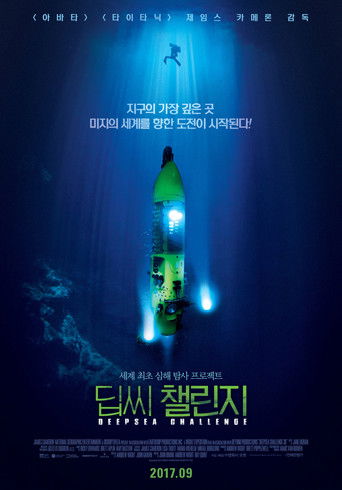
딥씨 챌린지 (2014)
Deepsea Challenge 3D
제임스 카메론 감독, 세계 최초 심해 탐사 프로젝트 ‘딥씨 챌린지’에 도전하다!
10대 시절, 영화보다 해양탐사에 더 관심이 많았던 제임스 카메론. 오늘은 세계적 명성을 가진 영화감독이 아닌, 누구보다 열정적인 내셔널 지오그래픽 전속 해양 탐험가로서의 오랜 꿈을 이루기 위해 인류의 마지막 미개척지 마리아나 해구에 진입한다. 7년간의 노력 끝에 탄생한 잠수정 ‘딥씨 챌린저’와 함께 지구에서 가장 깊은 곳을 향해 잠수를 시작한 그는 그곳에서 새로운 세상을 마주하게 된다.
- 개봉일
- 2014-08-08
- TMDB
- 6.7 / 10 (63)
- 상영 시간(분)
- 1시간 30분
- 장르
- 다큐멘터리
- 감독
- Andrew Wight, Raymond Quint, John Bruno
출연진
- 제임스 카메론 — Self
- Suzy Amis — Self
- Frank Lotito — Giuseppe Buono
- Lachlan Woods — Jacques Piccard
- Paul Henri — Don Walsh
흥미로운 사실
Deepsea Challenger is a 7.3-metre (24 ft) deep-diving submersible designed to reach the bottom of the Challenger Deep, the deepest-known point on Earth. On 26 March 2012, Canadian film director James Cameron piloted the craft to accomplish this goal in the second crewed dive reaching the Challenger Deep. Built in Sydney, Australia, by the research and design company Acheron Project Pty Ltd, Deepsea Challenger includes scientific sampling equipment and high-definition 3-D cameras; it reached the ocean's deepest point after two hours and 36 minutes of descent from the surface.
Development
Deepsea Challenger was built in Australia, in partnership with the National Geographic Society and with support from Rolex, in the Deepsea Challenge program. The construction of the submersible was headed by Australian engineer Ron Allum. Many of the submersible developer team members hail from Sydney's cave-diving fraternity including Allum himself with many years of cave-diving experience.
Working in a small engineering workshop in Leichhardt, Sydney, Allum created new materials including a specialized structural syntactic foam called Isofloat, capable of withstanding the huge compressive forces at the 11-kilometre (6.8 mi) depth. The new foam was unique in that it was more homogeneous and possessed greater uniform strength than other commercially available syntactic foam.
The foam's strength enabled the Deepsea Challenger designers to incorporate thruster motors as part of the infrastructure mounted within the foam but without the aid of a steel skeleton to mount various mechanisms. The foam supersedes gasoline-filled tanks for flotation as used in the historic bathyscaphe Trieste.
Allum also built many innovations, necessary to overcome the limitations of existing products (and presently undergoing development for other deep sea vehicles). These include pressure-balanced oil-filled thrusters; LED lighting arrays; new types of cameras; and fast, reliable penetration communication cables allowing transmissions through the hull of the submersible.
Power systems for the submarine were supplied by lithium batteries that were housed within the foam and can be clearly seen through clear plastic panels. The lithium battery charging systems were designed by Ron Allum.
위키백과에서 더 읽기 · 텍스트 출처: 위키백과, CC BY-SA 4.0. 데이터 출처: Wikidata.
추천
- Deep Blue 2003 · ★ 6.9
- 가장 깊은 호흡 2023 · ★ 7.6
- 신비의 바다 2006 · ★ 6.6
- 상어의 속삭임 2025 · ★ 6.7
- 최후의 호흡 2019 · ★ 7.5
- 심해의 영혼들 2003 · ★ 6.8
- 나코이카시 2002 · ★ 6.2
- 포와카시 1988 · ★ 7.2
- 에이리언 오브 더 딥 2005 · ★ 6.0
- 데이비드 애튼버러: 바다 2025 · ★ 8.1
- 퍼프: 산호초의 경이로움 2021 · ★ 7.7
- 나의 문어 선생님 2020 · ★ 7.9