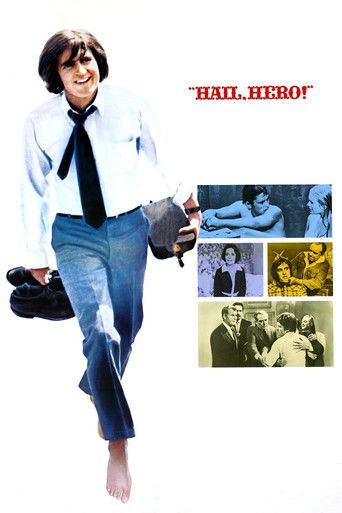
Hail, Hero! (1969)
Carl Dixon decides to quit school and enlist in the Army, even though he's already run afoul of the law as a Vietnam protestor. It is our hero's intention to use love, rather than bullets, to combat the Viet Cong. Needless to say, his idealism is no match for the harsher realities of war.
- 上映日期
- 1969-10-04
- TMDB
- 6.5 / 10 (2)
- 片长(分钟)
- 1小时40分钟
- 类型
- 剧情
- 导演
- David Miller
演员阵容
- 阿瑟·肯尼迪 — Albert Dixon
- Teresa Wright — Santha Dixon
- 迈克尔·道格拉斯 — Carl Dixon
- 约翰·拉奇 — Mr. Conklin
- Louise Latham — Miss Mirabel
- Charles Drake — Senator Murchiston
- 彼得·施特劳斯 — Frank Dixon
- Deborah Winters — Rebecca
- Mercer Harris — Jimmy
- 弗吉尼亚·克里斯汀 — Eleanor Murchiston
- Mario Alcalde — Congressman Arcado
- Amy Stuart — Rhetha
趣闻
Hail, Hero! is a 1969 drama film directed by David Miller, starring Michael Douglas, Deborah Winters and Peter Strauss. David Manber wrote the screenplay based on the novel by John Weston. The picture was produced by Harold D. Cohen and was the feature film debut for Douglas and for Peter Strauss. It was a critical and commercial failure.
Production
David Miller initially rejected Douglas for the part. Douglas's biographer, Marc Eliot, recounts that Miller was not initially aware he was Kirk Douglas's son. When Michael Douglas's agent told him about that, with his client's knowledge, it "resonated with Miller and not necessarily in a positive way" as Miller had negative experiences with the father when directing him in Lonely Are the Brave.
Douglas was frequently asked whether his father had helped him get the role, which he denied, saying that he was cast on the strength of his performance in the CBS Playhouse drama The Experiment, and such questions "visibly annoyed him." Kirk Douglas denied that he played a role in the casting of his son.
Gordon Lightfoot contributed two songs to the soundtrack, the title song (co-written with Jerome Moross) and "Wherefore And Why", an "alternate, slightly faster take" of the first track of Did She Mention My Name? No soundtrack album was released.
A key scene in the film was changed shortly before the film's release. In both the novel and the film, "Carl spends his last night at home painting the side of his father's barn with a Pop war mural—flowers, bombs, flaming planes and an American flag in which hearts have replaced the stars. In the novel (and in the film before it was ... re-edited), Carl's mother ... and father joined him in this act of affirmation."
Deirdre Flynn, daughter of Errol Flynn, who then was working as a stunt performer, was Douglas's stand-in during filming of the movie.
在维基百科阅读更多 · 文本来自维基百科,CC BY-SA 4.0。数据来自 Wikidata。