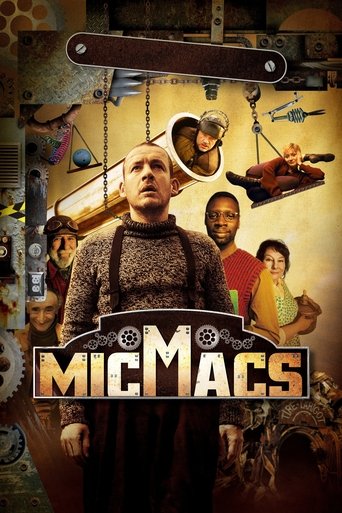
Micmacs (2009)
Micmacs à tire-larigot
Non Stop Madness.
While standing in the doorway of the video shop where he works, Bazil is inadvertently shot in the head. Now homeless and jobless, he is taken in by a troupe of misfits who live in a giant mound of trash. There Bazil begins his quest for revenge against the people who produced the gun that shot him.
- Date of release
- 2009-10-28
- TMDB
- 6.6 / 10 (703)
- Runtime
- 1h 44m
- Genres
- Action, Comedy, Crime
- Director
- Jean-Pierre Jeunet
Casting
- Dany Boon — Bazil
- Dominique Pinon — Fracasse
- André Dussollier — Nicolas Thibault De Fenouillet
- Jean-Pierre Marielle — Placard
- Julie Ferrier — Rubber Kid
- Yolande Moreau — Tambouille
- Michel Crémadès — Petit Pierre
- Nicolas Marié — François Marconi
- Omar Sy — Remington
- Marie-Julie Baup — Calculette
- Philippe Girard — Gravier
- Thérèse Roussel — Old Lady in Bed
Interesting facts
- Filmed in: Paris, Morocco, and City 212 Social Housing
Micmacs is a 2009 French comedy film by French director Jean-Pierre Jeunet. Its original French title is MicMacs à tire-larigot. The film is billed as a "satire on the world arms trade." It premiered on 15 September 2009 at the 2009 Toronto International Film Festival as a gala screening at Roy Thomson Hall.
Production
Jean-Pierre Jeunet originally wrote the character of Bazil for Jamel Debbouze, but Debbouze left the project after three weeks, citing artistic and financial disagreements. The role was later given to Dany Boon.
Jeunet toured arms manufacturing plants in Belgium for research when developing the film. Some dialogue was taken directly from interviews from arms dealers. The sabotaged machine in De Fenouillet's factory was modeled exactly after an actual machine in a plant which Jeunet visited.
The film was shot in several locations in and around Paris including the exterior of the Musée d'Orsay and the Crimée bridge on the Canal de l'Ourcq, where the Marcel Carné's 1946 film Gates of the Night was shot. Jeunet also filmed in several train stations, including Gare de Lyon, Gare Saint-Lazare, and the Charles De Gaulle airport train station.
The scene with the two CEOs in the desert was inspired by Sergio Leone's Once Upon a Time in the West. The subsequent flashback sequence was inspired by Brian De Palma's Mission: Impossible.
Though the film contains no obvious special effects sequences, digital color manipulation is used throughout, and specific digital manipulations were used on about 350 shots. These manipulations often involved removing people and objects in backgrounds of scenes shot on Paris streets.
Read on Wikipedia · Text from Wikipedia, CC BY-SA 4.0. Data from Wikidata.
Recommended
- Who Is Cletis Tout? 2001 · ★ 5.9
- Walking Tall: The Payback 2007 · ★ 5.9
- Cotton Comes to Harlem 1970 · ★ 6.2
- Afterburn 2025 · ★ 6.2
- The Last Days of American Crime 2020 · ★ 6.4
- Accident Man 2018 · ★ 6.3
- Reckless 2026 · ★ 6.6
- Wire Room 2022 · ★ 6.0
- Trap House 2025 · ★ 6.6
- Misdirection 2026 · ★ 6.2
- Accident Man: Hitman's Holiday 2022 · ★ 6.8
- Run All Night 2015 · ★ 6.4