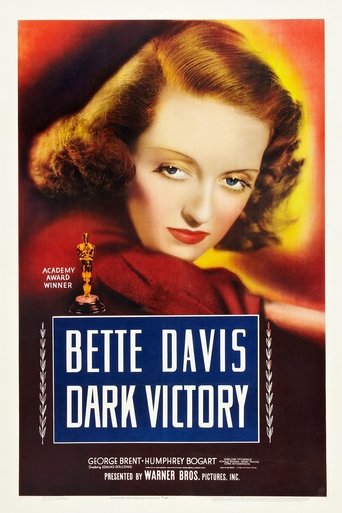
Dark Victory (1939)
I've crammed every minute so full of waste. And now there's so little time. I don't know what to do. I'm afraid!
Socialite Judith Traherne lives a lavish but emotionally empty life. Riding horses is one of her few joys, and her stable master is secretly in love with her. Told she has a brain tumor by her doctor, Frederick Steele, Judith becomes distraught. After she decides to have surgery to remove the tumor, Judith realizes she is in love with Dr. Steele, but more troubling medical news may sabotage her new relationship, and her second chance at life.
- Date of release
- 1939-04-20
- TMDB
- 7.0 / 10 (170)
- Runtime
- 1h 44m
- Genres
- Drama, Romance
- Director
- Edmund Goulding
Casting
- Bette Davis — Judith Traherne
- George Brent — Dr. Frederick Steele
- Humphrey Bogart — Michael O'Leary
- Geraldine Fitzgerald — Ann King
- Ronald Reagan — Alec
- Henry Travers — Dr. Parsons
- Cora Witherspoon — Carrie
- Dorothy Peterson — Miss Wainwright
- Virginia Brissac — Martha
- Charles Richman — Colonel Mantle
- Herbert Rawlinson — Dr. Carter
- Leonard Mudie — Dr. Driscoll
Interesting facts
- Based on: Dark Victory
- Awards: 0 · Nominations: 3
Dark Victory is a 1939 American melodrama film directed by Edmund Goulding, starring Bette Davis, and featuring George Brent, Humphrey Bogart, Geraldine Fitzgerald, Ronald Reagan, Henry Travers, and Cora Witherspoon. The screenplay by Casey Robinson was based on the 1934 play of the same title by George Brewer and Bertram Bloch, starring Tallulah Bankhead.
Production
Tallulah Bankhead originated the role of Judith Traherne in the Broadway production, which ran for 51 performances at the Plymouth Theatre, before being cut short when Bankhead fell ill with a bacterial infection. Davis openly admitted in later years that she had emulated Bankhead in the role. In 1935, David O. Selznick wanted to cast Greta Garbo and Fredric March in the leads, but Garbo chose to play the lead in Anna Karenina instead.
When Bette Davis discovered the play in 1938, she shopped it to every producer on the Warners lot, and Hal Wallis bought the rights from Selznick for her, for $50,000, when director Edmound Goulding and producer David Lewis showed interest in the project.
According to another account, Casey Robinson, the writer, had wanted to buy the play ever since he saw it on stage, knowing how to adapt it. He lost the rights to David O. Selznick but when Selznick decided not to make it, recommended Hal Wallis buy it for Warners. Robinson said:
The play was about a rich, spoiled girl who gets carcinoma of the brain and is going to die. In the second act she learns she is going to die and accepts it gallantly... They just had a lot of gabble in the third act that meant nothing. There had to be, in the middle of the piece, a period of great rebellion against fate—of anger, which, of course, was mixed up with her love for the doctor. Also, the anger that she hadn’t been told, and so on.
Robinson decided the film would be about two things, love and death:
Read on Wikipedia · Text from Wikipedia, CC BY-SA 4.0. Data from Wikidata.
Recommended
- Five Feet Apart 2019 · ★ 8.2
- Until Forever 2016 · ★ 7.6
- The Theory of Everything 2014 · ★ 7.8
- All My Life 2020 · ★ 7.7
- A Walk to Remember 2002 · ★ 7.7
- Wild Hearts Can't Be Broken 1991 · ★ 7.3
- Marvin's Room 1996 · ★ 6.7
- Phenomenon 1996 · ★ 6.5
- Third Star 2010 · ★ 7.0
- The Music Never Stopped 2011 · ★ 7.1
- 2 Hearts 2020 · ★ 7.2
- The Pride of the Yankees 1942 · ★ 7.3