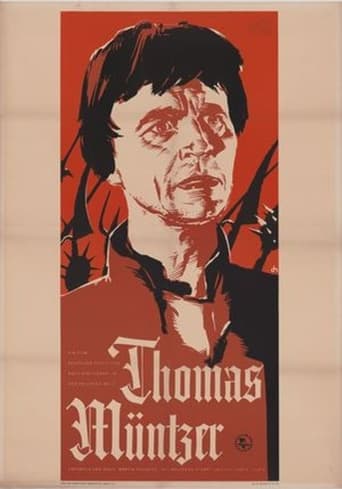
Thomas Müntzer (1956)
Thomas Müntzer – Ein Film deutscher Geschichte
In 1523, young Thomas Müntzer arrives with his wife Ottilie in the Thuringian village Allstedt to assume the rectorate. As a follower of Luther′s teachings, he finds in the Bible not only reasons for clerical, but also for secular reforms. But when Luther turns away from the rural population after a discord with Müntzer, it is Müntzer who becomes the peoples′ spokesman. He is forced to go to Southern Germany, where he convenes with revolting farmers. But his way leads him back to Thuringia. In 1525, he and Heinrich Pfeiffer form the centre of the Thuringian peasant uprising in Mühlhausen, but their success is diminished by the fact that peasants and craftsmen don′t seem to be able to work together. In Frankenhausen, Müntzer becomes the leader of a peasants′ army that is set to fighting the ruler′s army – and sustains a devastating loss. Müntzer is arrested and sentenced to death by decapitation for his insurgency.
- Date of release
- 1956-05-16
- TMDB
- 8.0 / 10 (1)
- Runtime
- 2h 11m
- Genres
- Drama, History
- Director
- Martin Hellberg
Casting
- Wolfgang Stumpf — Thomas Müntzer
- Margarete Taudte — Ottilie von Gersen
- Wolf Kaiser — Schwabenhannes
- Martin Flörchinger — Heinrich Pfeiffer
- Wolfgang Kaehler — Markus Stübner
- Heinz Giese — Hans Buss
- Ruth-Maria Kubitschek — Bärbel Buss
- Albert Garbe — Bauer Barthel
- Maly Delschaft — Frau Barthel
- Hans-Joachim Büttner — Veit
- Jochen Diestelmann — Gerber Martin
- Hans W. Hamacher — Apel Wynmeister
Interesting facts
Thomas Muentzer is a 1956 East German film about the life of the 16th-century Protestant theologian and peasant leader Thomas Muentzer, directed by Martin Hellberg.
Production
The communist leadership of East Germany, in its attempts to create a unifying narrative for the citizens of their country, attempted to portray the history of the land as a chain of events which developed according to the rules of Marxism-Leninism, leading unavoidably to the consolidation of socialist power in the state.
The film was one of 13 'heritage films' created by the DEFA studio during the 1950s about important historical characters whose legacy was deemed important by the state, like Johannes Kepler and Georg Buechner. Author Friedrich Wolf began working on the scenario in the late 1940s, and director Hellberg requested the DEFA board to authorize a film about Muentzer in 1952.
Read on Wikipedia · Text from Wikipedia, CC BY-SA 4.0. Data from Wikidata.
Recommended
- Corsage 2022 · ★ 6.1
- Home from Home – Chronicle of a Vision 2013 · ★ 7.8
- Radium Girls 2020 · ★ 6.6
- The Tasters 2025 · ★ 6.7
- Oranges and Sunshine 2010 · ★ 6.9
- The Current War 2018 · ★ 6.7
- The Forger 2022 · ★ 6.2
- Adventures of a Mathematician 2021 · ★ 6.1
- The Enigma of Kaspar Hauser 1974 · ★ 7.3
- Rabiye Kurnaz vs. George W. Bush 2022 · ★ 6.2
- Snow Flower and the Secret Fan 2011 · ★ 6.1
- My Dinner with Hervé 2018 · ★ 6.3