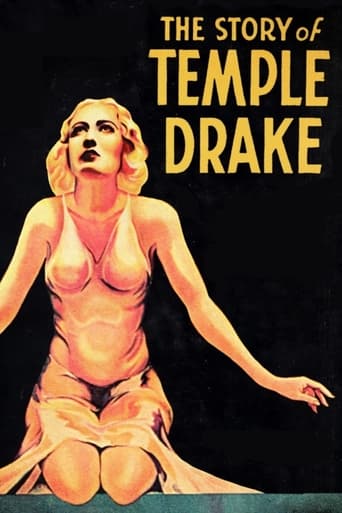
可怜美玉陷泥淖 (1933)
The Story of Temple Drake
一个富有但神经质的南方美女发现自己被困在一伙恶毒的私酒贩子的藏身处。该团伙的头目对她垂涎三尺,并决心不让任何事情妨碍他拥有她。
演员阵容
- Miriam Hopkins — Temple Drake
- 威廉·加根 — Stephen Benbow
- Jack La Rue — Trigger
- Florence Eldridge — Ruby Lemarr
- Guy Standing — Judge Drake
- Irving Pichel — Lee Goodwin
- Jobyna Howland — Miss Reba
- William Collier Jr. — Toddy Gowan
- Elizabeth Patterson — Aunt Jennie
- James Eagles — Tommy
- Harlan Knight — Pap
- James Pier Mason — Van
趣闻
The Story of Temple Drake is a 1933 American pre-Code Southern Gothic drama film directed by Stephen Roberts and starring Miriam Hopkins and Jack La Rue. It tells the story of Temple Drake, a reckless woman in the American South who falls into the hands of a brutal gangster and rapist. It was adapted from the highly controversial 1931 novel Sanctuary by William Faulkner. Though some of the more salacious elements of the source novel were not included, the film was still considered so indecent that it helped give rise to the strict enforcement of the Hays Code.
Production
In 1932, Paramount Pictures acquired the rights to the film's basis, the controversial novel Sanctuary (1931) by William Faulkner, for $6,000. Faulkner's novel dealt with a young Southern debutante held captive by a gang member and rapist. As the public felt the novel had a racy reputation, the film received a new title as the plot had been made more mild and to avoid associating it with the source work.
The credits only stated that Faulkner wrote the original novel. Robert Littell, who wrote a review of the film published in The New Republic on June 14, 1933, stated that the film producers also consulted Faulkner; statements about this are not present in the credits.
Several alterations were made to the screenplay that deviated from the source material: For example, in the novel, the judge is Temple's father; Gene D. Phillips of Loyola University of Chicago stated that "presumably" to make it more believable that he is "ineffectual" with her, he was changed into being her grandfather. For a short period before the film went into production, it was tentatively titled The Shame of Temple Drake.
The relatively upbeat ending of the film is in marked contrast to the ending of Faulkner's novel Sanctuary, in which Temple perjures herself in court, resulting in the lynching of an innocent man. E. Pauline Degenfelder of Worcester Public Schools wrote that the characterization of Temple differs from that of the novel version, and that the film gives her a "dual nature", dark and light.
Miriam Hopkins, who was cast in the titular role of Temple Drake, was a newcomer at the time of filming, and had only begun establishing herself in two Ernst Lubitsch films: The Smiling Lieutenant (1931) and Trouble in Paradise (1932). Hopkins' mother was reportedly upset that her daughter was portraying a rape victim.
在维基百科阅读更多 · 文本来自维基百科,CC BY-SA 4.0。数据来自 Wikidata。