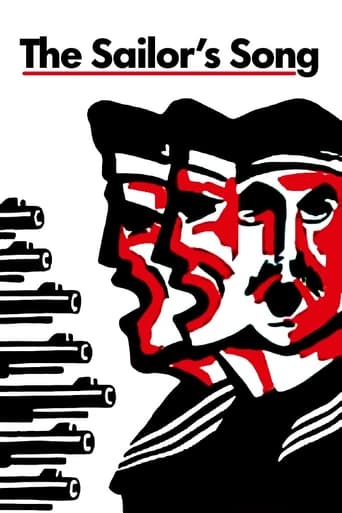
The Sailor's Song (1958)
Das Lied der Matrosen
A film about the historical uprising of the seamen in Kiel: During the Russian October Revolution of 1917, German and Russian soldiers start to solidarize with each other. By disarming the officers, machinist Henne Lonke and stoker Jens Kasten prevent the attack on a Russian freighter. When German admiralty gives out orders for operation "Nibelungen", which would lead the German fleet into a suicidal attack against England and quell the revolutionary spirit, seamen and soldiers from different political backgrounds unite in protest.
- Date of release
- 1958-11-09
- TMDB
- 6.2 / 10 (6)
- Runtime
- 2h 5m
- Genres
- History, Drama
- Director
- Kurt Maetzig, Günter Reisch
Casting
- Günther Simon — Erich Steigert
- Raimund Schelcher — August Lenz
- Ulrich Thein — Henne Lobke
- Horst Kube — Jens Kasten
- Hilmar Thate — Ludwig Batuschek
- Ekkehard Schall — Eberhard Schuckert
- Wolf von Beneckendorff — Von Resten
- Eduard von Winterstein — Hindenburg
- Werner Wieland — Noske
- Jochen Thomas — Sebastian Huber
- Sabine Thalbach — Lady from Luisenbund
- Horst Schönemann — Kapitän Wandres
Interesting facts
The Sailor's Song is an East German black-and-white film directed by Kurt Maetzig and Günter Reisch. It was released in 1958.
Production
The Sailor's Song was conceived in aftermath of the Socialist Unity Party's Conference on Cultural Affairs at October 1957, during which the East German establishment embraced a conservative line and ended the brief period of liberalization that begun after Nikita Khrushchev's Secret Speech. The Sailor's Song was commissioned shortly after, for the celebrations of the fortieth anniversary to the German Revolution.
The script writers Paul Wiens and Karl Georg Egel were instructed to present the 1918 Revolution in accordance with the official Soviet interpretation of history; Walter Ulbricht told that it failed due to the "opportunistic" Social Democrats and to the lack of a Marxist–Leninist party that would have led the workers "in the smashing of the capitalistic economical apparatus." The plot places emphasis on the Spartacus League, and culminates in the…
Principal photography commenced on June 3, 1958. Directors Kurt Maetzig and Günter Reisch worked separately; the former's crew was responsible for the scenes involving the officers and the admirals, while the latter filmed those with the sailors and the crowds. The Sailor's Song was the greatest project undertaken by DEFA up to that time, and was larger in scale even than Ernst Thälmann.
Read on Wikipedia · Text from Wikipedia, CC BY-SA 4.0. Data from Wikidata.
Recommended
- Born in Flames 1983 · ★ 6.2
- Mr. Turner 2014 · ★ 6.6
- The Most Hated Woman in America 2017 · ★ 6.2
- Iron Jawed Angels 2004 · ★ 6.8
- The Fox 2023 · ★ 7.1
- TalhotBlond 2012 · ★ 6.3
- Lucky Them 2013 · ★ 6.0
- Prizefighter: The Life of Jem Belcher 2022 · ★ 6.2
- Xiu Xiu: The Sent-Down Girl 1998 · ★ 7.2
- Hoodlum 1997 · ★ 6.5
- Radium Girls 2020 · ★ 6.6
- O.G. 2018 · ★ 5.9