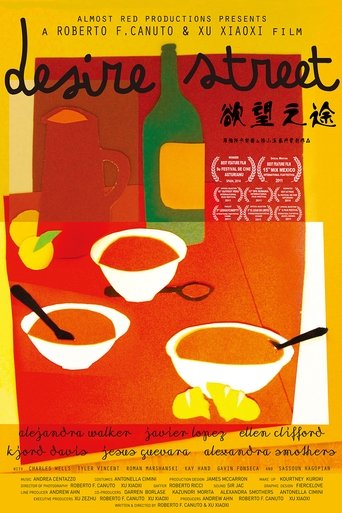
Desire Street (2011)
A family (mother, daughter and son) tries to survive their loneliness and obsessions by going through different sexual experiences and relationships with a new neighbour, a prostitute.
- Date of release
- 2011-05-20
- TMDB
- 6.2 / 10 (10)
- Runtime
- 1h 22m
- Genres
- Drama, Comedy
- Director
- Roberto F. Canuto, Xiaoxi Xu
Casting
- Alexandra Smothers — Lucy Bell
- Alejandra Walker — Carmen
- Ellen Clifford — Bess
- Javier Lopez — Andrea
- Kjord Davis — Johnny Black
- Jesus Guevara — Antonio
- Manuel Domenech — Kevin (as Tyler Vincent)
- Roman Marshanski — Sasha
- Charles Wells — Priest / Mr. Smith
- Gavin Fonseca — Mike
- Sassoun Hagopian — DVD Shop Attendant
- Kay Hand — Homeless/ Lobby Woman
Interesting facts
Desire Street is a 2011 comedy-drama film written and directed by Roberto F. Canuto and Xu Xiaoxi. The film features an ensemble cast including Alejandra Walker, Javier Lopez, Ellen Clifford, Kjord Davis, Jesus Guevara and Alexandra Smothers, with Charles Wells, Tyler Vincent, Roman Marshanski, Kay Hand, Gavin Fonseca and Sassoun Hagopian in supporting roles. Revolving around an eccentric and dysfunctional Mexican immigrant family living in Los Angeles, the film is divided into three parts, each one with a story reflecting a family member and the relationship that they establish with a new neighbor, a prostitute named Lucy Bell.
Production
The district of Koreatown, Los Angeles, serves as a backdrop for the story.
The film was initially conceived as the directors' thesis film as part of their MFA degree at the New York Film Academy (NYFA) in Hollywood. After the directors' graduation, the film was re-edited and the post-production was completed.
Desire Street was filmed on Super 16mm film and principal photography lasted three and half weeks, taking place in August 2009, with temperatures reaching 110 °F (43 °C) and higher.
The directors' intentions behind Desire Street were to explore the elements of sex and desire as the main themes of the film. They tried to create characters that, under different circumstances, either repress these instincts (due to influences from the society, personal tragedies, etc.) or use it freely as the hooker does in the film.
Canuto and Xu take as a reference the Mexican melodramas of the 1960s. They exaggerate the representation of the characters to accentuate the irony that is a basic element in the story, creating many situations of comedy. At the end of the story the family became the main reference for the individual survival.
Read on Wikipedia · Text from Wikipedia, CC BY-SA 4.0. Data from Wikidata.
Recommended
- Hot Milk 2025 · ★ 5.9
- This Is Where I Leave You 2014 · ★ 6.7
- Hard Truths 2024 · ★ 6.4
- Divine Secrets of the Ya-Ya Sisterhood 2002 · ★ 6.0
- Death at a Funeral 2007 · ★ 6.9
- The Locket 1946 · ★ 6.3
- Mothers' Instinct 2024 · ★ 6.8
- The Thing with Feathers 2025 · ★ 6.5
- Real Women Have Curves 2002 · ★ 6.1
- From Straight A's to XXX 2017 · ★ 5.9
- May December 2023 · ★ 6.6
- Sweetie 1989 · ★ 6.1