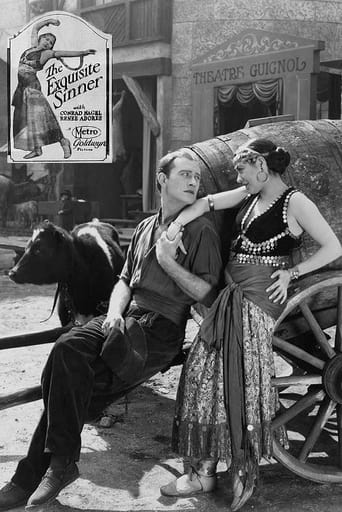
The Exquisite Sinner (1926)
Adapted by Alice Duer Miller from a novel by Alden Brooks, the film concerns a young man who forsakes the humdrum business world for the bohemian life of an artist. Josef von Sternberg had been the original director of Exquisite Sinner, but MGM was dissatisfied with the picture and refused to release it. When the film finally surfaced in 1926 (a full year after its completion), it had been radically altered by staff director Phil Rosen.
- Date of release
- 1926-03-28
- TMDB
- 8.0 / 10 (1)
- Runtime
- 1h 0m
- Genres
- Drama, Romance
- Director
- Josef von Sternberg, Phil Rosen
Casting
- Conrad Nagel — Dominique Prad
- Renée Adorée — Silda
- Paulette Duval — Yvonne
- Frank Currier — Colonel
- George K. Arthur — Colonel's Orderly
- Matthew Betz — Gypsy Chief
- Helena D'Algy — Dominique's Sister
- Claire Du Brey — Dominique's Sister
- Myrna Loy — Living Statue
Interesting facts
The Exquisite Sinner is a 1926 American silent drama film directed by Josef von Sternberg and adapted by Alice Duer Miller from the novel Escape by Alden Brooks. Starring Conrad Nagel and Renée Adorée, the Metro-Goldwyn-Mayer (MGM) never given a general release. No known print of the film has been recovered to date. Later that same year a second feature film Heaven on Earth, directed by Phil Rosen was released with the same cast and same sets, but a different screenplay. Rosen's version performed poorly at the box office. Sternberg reported, "the result was two ineffective films instead of one.” The American Film Institute Catalog Feature Films: 1921-30 by The American Film Institute.
Production
The Exquisite Sinner was filmed in Hollywood during February 1925. Robert Florey, the films assistant director, provides a sketch of Sternberg's on-set persona in the journal Hollywood d'hier et d'aujourd'hui.
"At 8:45 Sternberg arrived on the set. All actors were lined up. He passed before them in review, inspecting them from head to foot, their sergeant-major waiting at a respectful distance. When he arrived at the twenty-first gendarme, Sternberg stopped, hypnotizing the poor man.
Metro-Goldwyn-Mayer had recently endured the “Teutonic tantrums” exhibited by director Erich von Stroheim during the filming of The Merry Widow and were not amused by Sternberg's histrionics. As the production proceeded, studio executives began to doubt Sternberg's commitments to satisfying their expectations of a commercial success.
When MGM reviewed the “finished version”, the film was deemed “photographically and pictorially [impressive]...But it is in vain we look for the theme of the story.” An MGM staff reader considered it “well worthwhile to reconstruct the story and the picture” through re-editing, as well as “injecting some vital sequences.” After a rigorous re-working and a new title - The Exquisite Sinner - the film was previewed to a test audience in March 1925 a…
In an effort to salvage The Exquisite Sinner, “MGM set its veteran director Phil Rosen to work on a second version of the film…using the same stars.” This demonstrates that the studio was in a position financially and organizationally to delay release of a major production and “in the meantime entirely rescript and reshoot the film under another director in an attempt to produce a certain profit-earner.” The movie was re-scripted as “a bitterswee…
Read on Wikipedia · Text from Wikipedia, CC BY-SA 4.0. Data from Wikidata.
Recommended
- The Secret: Dare to Dream 2020 · ★ 7.4
- Désirée 1954 · ★ 6.6
- Kitty Foyle 1940 · ★ 6.6
- The Sleeping Dictionary 2003 · ★ 6.6
- The Lost Husband 2020 · ★ 6.7
- The Last Station 2009 · ★ 6.4
- Flamingo Road 1949 · ★ 7.0
- Nobody Has to Know 2022 · ★ 6.7
- They Won't Believe Me 1947 · ★ 6.6
- Wuthering Heights 1970 · ★ 6.4
- The Magic of Ordinary Days 2005 · ★ 7.5
- Pride and Prejudice 1940 · ★ 6.9