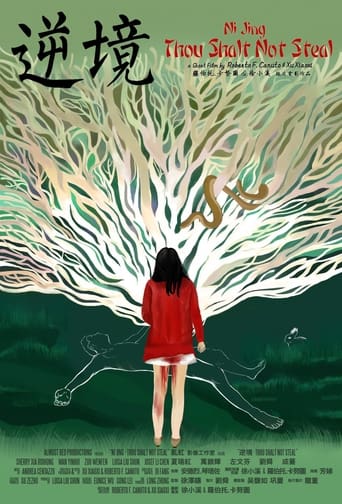
Ni Jing: Thou Shalt Not Steal (2013)
Ni Jing
Amanece en Chengdu (China). Una joven, Wu Xiaofan, despierta aterrorizada y desorientada en un paraje remoto al notar cómo una serpiente recorre su mano. Se da cuenta de que su ropa está ensangrentada y siente un gran dolor que apenas le permite caminar. Mientras busca una salida, descubre una bolsa de plástico con una cabeza de conejo. En su intento de regresar a casa, será víctima de la insolidaridad de la gente y objeto de críticas. Poco a poco, a su mente vendrán imágenes que la harán comprender que todo lo le está pasando está relacionado con su novio, Chen Zhong, del que está enamorada. Traición, mentiras y el sueño de un futuro mejor determinarán un destino incierto.
- Fecha de estreno
- 2013-11-09
- TMDB
- 8.1 / 10 (8)
- Duración
- 29 min
- Géneros
- Drama, Misterio, Romance
- Director
- Xiaoxi Xu, Roberto F. Canuto
Reparto
- Sherry Xia Ruihong — Wu Xiaofan
- Yinhui Wan — Chen Zhong
- Wenfen Zuo — Villager
- Luisa Shun Liu — Young Villager
- Josef Chen Li — Car Owner
- Alicia Barbadoux — Foreign Friend
- Ye Kuang — Zhong's Friend
Curiosidades
Ni Jing: Thou Shalt Not Steal is a 2013 Spanish and Chinese co-production drama film written and directed by Roberto F. Canuto and Xu Xiaoxi. The film represents one of the rare independent film collaborations between Spain and China, together with the previous film from the directors, Desire Street. The film is based in a true story that happened to a close friend of the directors and it was shot in Chengdu, China, using the local dialect of the region, the Sichuanese Mandarin.
Production
Ni Jing: Thou Shalt Not Steal is the first film shot in China by the directors, after their previous experiences in Los Angeles and South Africa. The principal photography took place in the Summer 2012 and the post-production was completed in 2013.
The film was shot in real locations in Chengdu and surrounding areas, such as: Chengdu City Center, the more traditional urban areas and mountain restaurants of the Sichuan region, the forest at Qing Chen mountain as well as different roads that connect these locations.
Ni Jing: Thou Shalt Not Steal is the first part of a trilogy called Invisible Chengdu, directed by Roberto F. Canuto and Xu Xiaoxi, following by Floating Melon (2015) and Sunken Plum (2017). The trilogy focuses on characters that usually are kept underground and discriminated in the Chinese society, and often not well represented in the silver screen.
According to the directors, in Ni Jing: Thou Shalt not steal they "wanted to represent the different ways in which young people confront relationships in Asia. The perspective is very different for males and females, and pressure from the family is really strong. We do not try to teach or give advice on how things should to be handled; our aim is just to make people think about the nature of such issues, and whether they are right or wrong.
Leer en Wikipedia · Texto de Wikipedia, CC BY-SA 4.0. Datos de Wikidata.
Recomendadas
- Her Story 2024 · ★ 7.6
- Amor bajo el espino blanco 2010 · ★ 7.8
- Kaili Blues 2016 · ★ 7.1
- Summer Palace 2007 · ★ 7.4
- La casa de Navidad de Thomas Kinkade 2008 · ★ 6.3
- Amar te duele 2002 · ★ 8.2
- Todo lo que nunca fuimos 2026 · ★ 8.3
- Hermandad de Espadas 2014 · ★ 6.7
- La buena tierra 1937 · ★ 6.3
- Spring Fever 2010 · ★ 6.2
- Ali y Nino 2016 · ★ 6.5
- Jade Dynasty 2019 · ★ 7.4