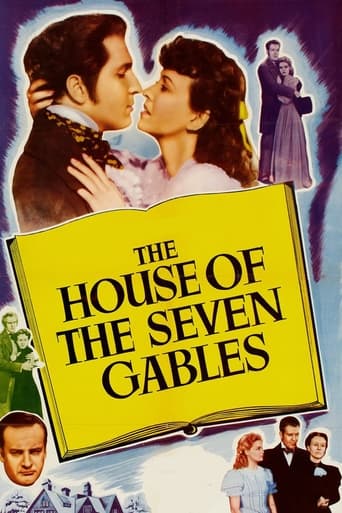
The House of the Seven Gables (1940)
AN ANCIENT HOUSE! A MURDER SECRET! A HIDDEN TREASURE!
In 1828, the bankrupt Pyncheon family fight over Seven Gables, the ancestral mansion. To obtain the house, Jaffrey Pyncheon obtains his brother Clifford's false conviction for murder. Hepzibah, Clifford's sweet fiancée, patiently waits twenty years for his release, whereupon Clifford and his former cellmate, abolitionist Matthew, have a certain scheme in mind.
- Date of release
- 1940-04-12
- TMDB
- 7.0 / 10 (33)
- Runtime
- 1h 29m
- Genres
- Thriller, Drama, Romance
- Director
- Joe May
Casting
- George Sanders — Jaffrey Pyncheon
- Margaret Lindsay — Hepzibah Pyncheon
- Vincent Price — Clifford Pyncheon
- Nan Grey — Phoebe Pyncheon
- Dick Foran — Matthew Maule
- Cecil Kellaway — Philip Barton
- Alan Napier — Fuller
- Gilbert Emery — Gerald Pyncheon
- Miles Mander — Deacon Arnold Foster
- Charles Trowbridge — Judge
- Harry Cording — Blacksmith Hawkins
- Michael Mark — Ex-Convict
Interesting facts
- Awards: 0 · Nominations: 1
The House of the Seven Gables is a 1940 Gothic drama film based on the 1851 novel of the same name by Nathaniel Hawthorne. It stars George Sanders, Margaret Lindsay, and Vincent Price, and tells the story of a family consumed by greed in which one brother frames another for murder. It is a remake of the 1910 film of the same name, which starred Mary Fuller. The film's musical score was nominated for the Oscar for Best Original Score. The plot of the film differs dramatically from that of Hawthorne's novel.
Production
The House of the Seven Gables was first filmed by Edison Studios in 1910. This version, which is now lost, starred Mary Fuller. Republic Pictures announced a remake in 1935, but it went into development hell and was never made.
Universal Studios began planning its remake of The House of the Seven Gables probably in early 1939. Pre-production for the film was secretive, as the studio feared that other companies with more financial resources might rush a House of Seven Gables into production before Universal could finish its version. The studio wanted the picture to be a low-budget B film, which would be released as a double feature with another B film.
Screenwriter Lester Cole says it was unclear why Universal chose to make the film, although it may have been because the book was in the public domain. Film historian Don G. Smith, however, argues for an economic reason: Horror films were popular again. A national outcry against the gruesomeness of the 1935 film The Raven had convinced Universal Studios executives to place a ban on the production of horror films at the studio.
Universal announced it would begin work on The House of the Seven Gables on October 10, 1939. The studio assigned one of its B-picture producers, Burt Kelly, to oversee the production. Kelly had an extensive background in theater, and had held a number of associate producer and producer positions at various studios. Universal also assigned one of its young staff writers, Harold Greene, to produce a treatment of the novel.
The lengthy novel by Nathaniel Hawthorne needed extensive cutting to turn it into a filmable script. Cole substantially cut much of the beginning of the novel, and altered a good deal of the plot—remaining faithful to the spirit of the novel if not its actual narrative. But Cole did more than adapt the novel. He purposefully injected extensive left-wing political views into the script.
Read on Wikipedia · Text from Wikipedia, CC BY-SA 4.0. Data from Wikidata.
Recommended
- Time Without Pity 1957 · ★ 6.5
- Christmas Cottage 2008 · ★ 6.3
- The Dark Past 1948 · ★ 6.0
- One & Two 2015 · ★ 5.8
- Restless 2011 · ★ 6.5
- Sunrise: A Song of Two Humans 1927 · ★ 7.8
- The Reckless Moment 1949 · ★ 6.8
- Under Capricorn 1949 · ★ 6.0
- The Locket 1946 · ★ 6.3
- They Won't Believe Me 1947 · ★ 6.6
- Departure 2016 · ★ 6.3
- Peter Ibbetson 1935 · ★ 7.0