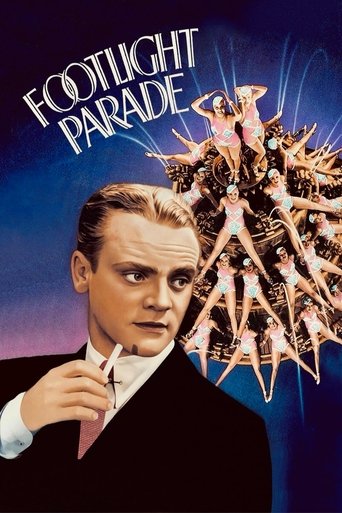
Footlight Parade (1933)
Climaxing Warner Bros.' glittering parade of musicals!
A fledgling producer finds himself at odds with his workers, financiers and his greedy ex-wife when he tries to produce live musicals for movie-going audiences.
- Date of release
- 1933-10-21
- TMDB
- 6.9 / 10 (110)
- Runtime
- 1h 44m
- Genres
- Comedy, Music
- Director
- Lloyd Bacon
Casting
- James Cagney — Chester Kent
- Joan Blondell — Nan
- Ruby Keeler — Bea
- Dick Powell — Scotty
- Frank McHugh — Francis
- Guy Kibbee — Gould
- Ruth Donnelly — Mrs. Gould
- Hugh Herbert — Bowers
- Claire Dodd — Vivian
- Gordon Westcott — Harry Thompson
- Arthur Hohl — Al Frazer
- Renee Whitney — Cynthia Kent
Interesting facts
- Box office: $2.4M
- Budget: $703K
- Earned 3.4× its budget
Footlight Parade is a 1933 pre-Code American musical film directed by Lloyd Bacon, with songs written by Harry Warren (music), Al Dubin (lyrics), Sammy Fain (music) and Irving Kahal (lyrics). The film's numbers were staged and choreographed by Busby Berkeley.
Production
Looking for a role different from the gangster films such as The Public Enemy that catapulted him to fame, Cagney actively campaigned for the lead role of Chester Kent, based on well-known impresario Chester Hale of the prologue production company Fanchon and Marco. Cagney had gotten his start in vaudeville and Broadway before going into film work; the film became his first on-screen appearance as a dancer.
While Powell's role was written specifically for him, he was replaced by Stanley Smith when he fell ill. When he recovered, Smith's scenes were reshot with Powell. The film became the third pairing of Powell and Ruby Keeler after 42nd Street (1933) and Gold Diggers of 1933, the first two Warner Bros. Busby Berkeley musicals. Similarly, Dorothy Tennant was initially cast as Harriet Gould, but replaced by Ruth Donnelly.
Warner Bros. initially signed for Larry Ceballos to choreograph the film when Berkely was unavailable. However, when Berkeley was able to make changes to his schedule, the studio let Ceballos go. Ceballos subsequently sued Berkeley and the studio for $100,000 for breach of contract.
Production took place at the Warner Bros. studio in Burbank, California between June and September 1933, costing an estimated $703,000 to make (equivalent to approximately $17,484,640 in 2025). It premiered on September 30, 1933, with a general release on October 21.
The film was made during the pre-Code era, and its humor is sometimes quite risqué, with multiple references to prostitution and suggestions of profanity largely unseen again in studio films until the 1960s, when the Production Code collapsed. For example, Dick Powell's character is being "kept" by Mrs. Gould until he falls in love with another girl.
Read on Wikipedia · Text from Wikipedia, CC BY-SA 4.0. Data from Wikidata.
Recommended
- Animal Crackers 1930 · ★ 6.9
- The Big Store 1941 · ★ 6.3
- A Song Is Born 1948 · ★ 6.5
- The Cocoanuts 1929 · ★ 6.5
- Bo Burnham: What. 2013 · ★ 7.8
- A Day at the Races 1937 · ★ 7.1
- Love Happy 1949 · ★ 5.8
- The Rutles: All You Need Is Cash 1978 · ★ 6.8
- Babes in Arms 1939 · ★ 6.4
- The Wiz Live! 2015 · ★ 7.0
- Sneakerella 2022 · ★ 5.9
- Arlo the Alligator Boy 2021 · ★ 6.8