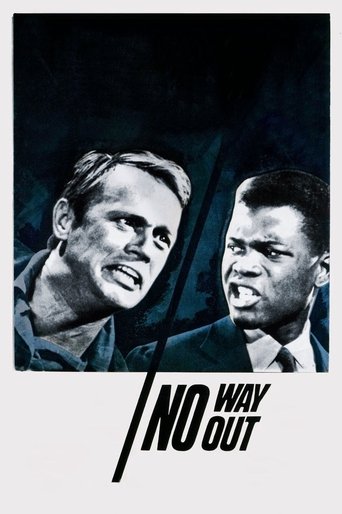
No Way Out (1950)
Is it a question... or an answer?
Two hoodlum brothers are brought into hospital for gunshot wounds, and when one dies, the other accuses their Black doctor of murder.
- Date of release
- 1950-08-16
- TMDB
- 7.0 / 10 (115)
- Runtime
- 1h 46m
- Genres
- Drama, Crime, Thriller
- Director
- Joseph L. Mankiewicz
Casting
- Richard Widmark — Ray Biddle
- Linda Darnell — Edie Johnson
- Sidney Poitier — Luther Brooks
- Stephen McNally — Dan Wharton
- Mildred Joanne Smith — Cora Brooks
- Harry Bellaver — George Biddle
- Stanley Ridges — Sam Moreland
- Dots Johnson — Lefty Jones
- Robert Adler — Louie (uncredited)
- Ernest Anderson — School Teacher (uncredited)
- Jessie Arnold — Woman (uncredited)
- Eleanor Audley — Wife (uncredited)
Interesting facts
- Awards: 1 · Nominations: 1. Including: National Board of Review: Top Ten Films
No Way Out is a 1950 American crime drama film noir directed by Joseph L. Mankiewicz and starring Sidney Poitier in his film debut, alongside Richard Widmark, Linda Darnell and Stephen McNally. The film centers on an African American doctor who confronts the racism of a poor slum after he treats a racist white criminal.
Production
Director Joseph Mankiewicz personally selected Sidney Poitier from a small group of finalists for the part of the young medical doctor Luther Brooks. Characterized by "emotional intensity and grace", the part launched Poitier's film career. The film also marks the first time that Ossie Davis (film debut) and Ruby Dee appeared together on screen, both uncredited.
In January 1949, Twentieth Century Fox acquired the film rights to Lesser Samuels's story and signed him to a ten-week contract to write the screenplay. Columbia, Paramount, Universal, and Warner Bros. also competed for the rights. Samuels initially aimed to write about "the cancerous results of hatred" without focusing on an African-American doctor until learning about their experiences from his daughter's fiancé, a doctor.
After acquiring Samuels's story, writer Philip Yordan made suggestions that were included in the final film, such as portraying "real Negroes and how they live, as human beings," with authentic family dynamics. Studio production head Darryl F. Zanuck produced the film and emphasized avoiding propaganda while creating a statement against intolerance.
Read on Wikipedia · Text from Wikipedia, CC BY-SA 4.0. Data from Wikidata.
Recommended
- Riot in Cell Block 11 1954 · ★ 7.1
- Brute Force 1947 · ★ 7.3
- The Sunchaser 1996 · ★ 6.3
- Killer's Kiss 1955 · ★ 6.3
- In the Heat of the Night 1967 · ★ 7.7
- Rosewood 1997 · ★ 6.5
- The Parts You Lose 2019 · ★ 6.6
- Winged Creatures 2009 · ★ 5.9
- The Caveman's Valentine 2001 · ★ 5.9
- Dark City 1950 · ★ 6.5
- House of Strangers 1949 · ★ 7.0
- Roman J. Israel, Esq. 2017 · ★ 6.3