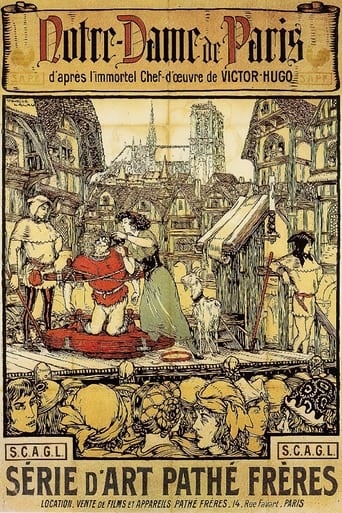
Notre-Dame de Paris (1911)
Esmeralda, a beautiful gypsy street dancer, arouses the desire of men, especially of Claude Frollo, the archdeacon of Notre Dame. The latter asks Quasimodo, the deaf and deformed bell-ringer of the cathedral, to kidnap the girl. Quasimodo, who has been adopted by Frollo and obeys his every word, captures the gypsy but she is saved thanks to Phoebus, a handsome captain, and his archers. Arrested by Phoebus, the hunchback is condemned to be flogged at the pillory. When Esmeralada, moved to pity by his lot, gives him water to drink, Quasimodo falls in love with her. Later, Phoebus is stabbed to death and Esmeralda is wrongly accused of the murder. Sentenced to hang, she is saved by Quasimodo who offers her asylum and... the love of his heart.
- Erscheinungsdatum
- 1911-01-02
- TMDB
- 5.4 / 10 (5)
- Laufzeit
- 38 Min.
- Genres
- Drama
- Regie
- Albert Capellani
Besetzung
- Henry Krauss — Quasimodo
- Stacia Napierkowska — Esmeralda
- René Alexandre — Phoebus de Chateaupers
- Claude Garry — Claudio Frollo
- Jean Angelo
- Paul Capellani
Wissenswertes
- Basiert auf: Der Glöckner von Notre-Dame
Notre-Dame de Paris ist ein Kurz- und Stummfilm aus dem Jahr 1911. Regie führte Albert Capellani, das Drehbuch schrieb Michel Carré auf Grundlage des Romans Der Glöckner von Notre-Dame von Victor Hugo. Die Rolle der Esmeralda spielte Stacia Napierkowska, den Glöckner gab Henry Krauss. Der Film hat eine Länge von 36 Minuten und wurde vom Filmstudio Pathé produziert. Er liegt heute lediglich noch in einer spanischen Version in schlechter Qualität vor.
Auf Wikipedia weiterlesen · Text aus Wikipedia, CC BY-SA 4.0. Daten aus Wikidata.
Empfohlen
- Passagiere der Nacht 2022 · ★ 6.9
- Padre 2018 · ★ 5.9
- Haute Couture - Die Schönheit der Geste 2021 · ★ 6.1
- My Brothers and I 2022 · ★ 7.2
- Salomé 2013 · ★ 6.1
- Der Glöckner von Notre Dame 1996 · ★ 7.1
- Come Sunday 2018 · ★ 5.8
- Hungry Hearts 2015 · ★ 6.5
- Das Hohelied der Liebe 1943 · ★ 6.9
- Irgendwann werden wir uns alles erzählen 2023 · ★ 5.8
- 1 Chance 2 Dance 2014 · ★ 6.2
- Chaos 2001 · ★ 6.4