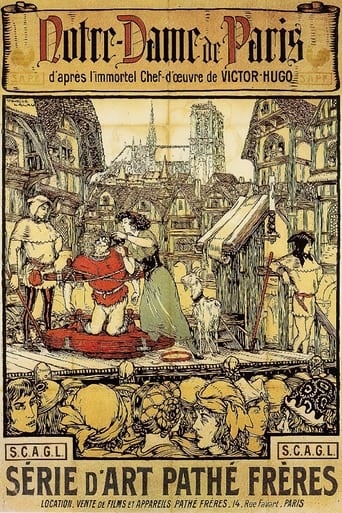
Notre-Dame de Paris (1911)
Esmeralda, a beautiful gypsy street dancer, arouses the desire of men, especially of Claude Frollo, the archdeacon of Notre Dame. The latter asks Quasimodo, the deaf and deformed bell-ringer of the cathedral, to kidnap the girl. Quasimodo, who has been adopted by Frollo and obeys his every word, captures the gypsy but she is saved thanks to Phoebus, a handsome captain, and his archers. Arrested by Phoebus, the hunchback is condemned to be flogged at the pillory. When Esmeralada, moved to pity by his lot, gives him water to drink, Quasimodo falls in love with her. Later, Phoebus is stabbed to death and Esmeralda is wrongly accused of the murder. Sentenced to hang, she is saved by Quasimodo who offers her asylum and... the love of his heart.
- Data lansării
- 1911-01-02
- TMDB
- 5.4 / 10 (5)
- Durată
- 38 min
- Genuri
- Dramă
- Regizor
- Albert Capellani
Distribuție
- Henry Krauss — Quasimodo
- Stacia Napierkowska — Esmeralda
- René Alexandre — Phoebus de Chateaupers
- Claude Garry — Claudio Frollo
- Jean Angelo
- Paul Capellani
Curiozități
- Bazat pe: Notre-Dame de Paris
The Hunchback of Notre Dame was a 1911 French film d'art silent film directed by Albert Capellani and produced by Pathé Frères. It was released under the name Notre-Dame de Paris. It starred Henry Krauss and Stacia Napierkowska. The film was based on the 1831 Victor Hugo novel The Hunchback of Notre-Dame. Considering the film's brief running time, critic Christopher Workman considered it "remarkably faithful to its source material" but it "contains no discernible humor, unlike most other horror films of the period, and thus represents a bellwether of sorts for the genre....(Henry Krauss as Quasimodo) "looks remarkably like Charles Ogle in (Thomas) Edison's 1910 Frankenstein."
Citește pe Wikipedia · Text din Wikipedia, CC BY-SA 4.0. Date din Wikidata.
Recomandate
- Pasagerii nopții 2022 · ★ 6.9
- The Padre 2018 · ★ 5.9
- Haute Couture 2021 · ★ 6.1
- Îngerii păcatului 1943 · ★ 6.9
- Salomé 2013 · ★ 6.2
- Eu și frații mei 2022 · ★ 7.2
- Cocoșatul de la Notre Dame 1996 · ★ 7.1
- Come Sunday 2018 · ★ 5.8
- Hungry Hearts 2015 · ★ 6.5
- Vreau să dansez 2014 · ★ 6.2
- The Dazzled 2019 · ★ 6.9
- Efectul razelor gamma asupra crăițelor 1972 · ★ 7.3