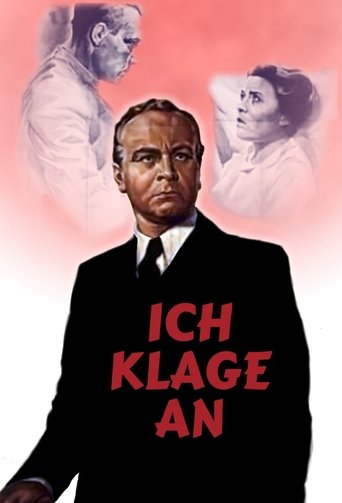
I Accuse (1941)
Ich klage an
In this film, the wife of a renowned doctor becomes ill with multiple sclerosis. Trying to spare her beloved husband the ordeal, the woman turns to a family friend, Dr. Lang, to help end her life. When this doctor declines to help with the assisted suicide, however, she is forced to turn to her husband. After much soul-searching, Dr. Heyt, her husband, assists in her suicide. The act, however, is witnessed by a chambermaid, who reports him to the police. Dr. Heyt is put on trial for murder and, at first, Dr. Lang testifies against him in court. Soon, however, Dr. Lang is faced with a similar case in his professional practice and this, along with Dr. Heyt’s impassioned performance in court, convinces Dr. Lang that, in some instances, mercy killing may be the right thing to do.
- Date of release
- 1941-08-29
- TMDB
- 6.2 / 10 (9)
- Runtime
- 2h 5m
- Genres
- Drama
- Director
- Wolfgang Liebeneiner
Casting
- Heidemarie Hatheyer — Hanna Heyt
- Paul Hartmann — Professor Dr. Thomas Heyt
- Mathias Wieman — Dr. Bernhard Lang
- Margarete Haagen — Berta Link
- Albert Florath — Prof. Schlüter
- Ilse Fürstenberg — Marie Günther
- Karin Evans — Erna Balg
- Hans Nielsen — Dr. Höfer
- Franz Schafheitlin — Rechtsanwalt Straten
- Erich Ponto — Prof. Werther
- Ernst Sattler — Major a.D. Döring
- Just Scheu — Dr. Scheu
Interesting facts
I Accuse is a 1941 Nazi German pro-euthanasia propaganda film directed by Wolfgang Liebeneiner and produced by Heinrich Jonen and Ewald von Demandowsky. It was developed to promote the involuntary euthanasia of disabled people conducted through the Aktion T4 mass murder program and to garner public support for the Nazi concept of life unworthy of life.
Production
Prior propaganda short films, such as Abseit vom Wege (By the Wayside) and Erbkrank (Congenitally Ill), were made in support of the Nazi's euthanasia policies, but were meant for ideological education and not for public release. Victor Brack convinced Tobis Filmkunst to produce a film about euthanasia after a public backlash to the policies.
This film was commissioned by Nazi propaganda minister Joseph Goebbels at the suggestion of Dr. Karl Brandt, to bolster public support for the Aktion T4 euthanasia program. Key scenes from the film were personally inserted by Brack, one of the prominent organisers of the program and later a convicted war criminal. The actual victims of T4 were in fact killed without their consent, or that of their families.
Heidemarie Hatheyer was banned from acting by the Allied occupation, but she resumed her career in 1949 and won numerous high-profile awards before her death. Liebeneiner was put on trial in 1964 as an accessory to mass murder for directing the film.
Read on Wikipedia · Text from Wikipedia, CC BY-SA 4.0. Data from Wikidata.
Recommended
- Good 2008 · ★ 6.0
- You Don't Know Jack 2010 · ★ 7.0
- Bastard Out of Carolina 1996 · ★ 7.1
- TalhotBlond 2012 · ★ 6.3
- Holy Lands 2019 · ★ 6.1
- Xiu Xiu: The Sent-Down Girl 1998 · ★ 7.2
- The Trials of Cate McCall 2013 · ★ 6.4
- Fog in August 2016 · ★ 7.4
- Play Dirty 1969 · ★ 6.3
- Guilty by Suspicion 1991 · ★ 6.5
- Skin 2009 · ★ 6.4
- Combat Girls 2011 · ★ 6.7