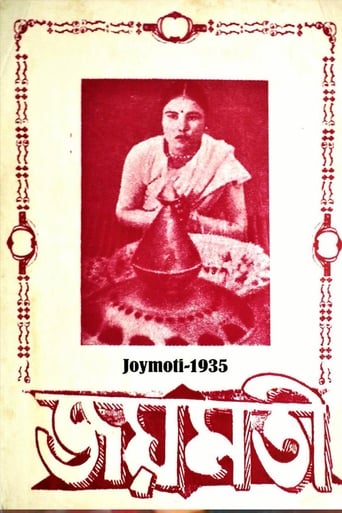
জয়মতী (1935)
In the late 17th century, a boy-king ruled the Ahom dynasty of Assam. But the executive power over the whole administration was vested on the Prime Minister. Owing to the presence of a large body of princes, each of whom was a positive material for insurrection, no king could sit on the throne safely. The Prime Minister, therefore, instituted search for the suitors to capture and kill them, or let off after mutilating thereby banning them for succession. The principal target of massacre was Godapani, a man of personal - vigor and energy. But Godapani became aware of The Prime Minister's design and fled to the Naga hills. Unable to trace Godapani, the army led by, one Gathi Hazarika, came upon his wife Joymoti. Gathi inflicted tortures on her to elicit the much sought-after information. She stuck to plea of ignorance, and replied to the increasing tortures by silence and patience. She breathed her last in the midst of torture.
- 개봉일
- 1935-03-10
- TMDB
- 9.0 / 10 (2)
- 상영 시간(분)
- 57분
- 장르
- 역사
- 감독
- Jyotiprasad Agarwala
출연진
- Aideu Handique — Joymati (as Asaideo Handige)
- Phanu Barua — Gada Paani
- Swargajyoti Barooah — Dalimi (as Swargajyoti Datta)
- Mohini Rajkumari
- Manabhiram Barua
- Phani Sarma — Gathi Hazarika
- Subha Barowa — Spy (Surang Suwa)
- Sneha Chandra Barua
- Naren Bardoloi
- Rana Barua
- Shamshul Haque
- Rajen Baruah
흥미로운 사실
Joymoti is a 1935 Indian film widely considered to be the first Assamese film ever made. Based on Lakshminath Bezbaroa's play about the 17th-century Ahom princess Joymoti Konwari, the film was produced and directed by the noted Assamese poet, author, and film-maker Jyoti Prasad Agarwala, and starred Aideu Handique and acclaimed stage actor and playwright Phani Sarma. The film, shot between 1933 and 1935, was released by Chitralekha Movietone on 10 March 1935 and marked the beginning of Assamese cinema.
Filming
According to Natasurya Phani Sarma, who played a key role in the film, Chitraban was not merely a studio, but a film-training institute in itself. Apart from the acting, Jyoti Prasad also taught his actors certain film-making techniques—such as developing, processing, printing, and editing—and shared with them his knowledge of various film shots like mixed shot, fade out, zoom, dissolve, back projection, and model shooting.
Although shooting at the Chitraban Studio started in April 1933, it faced an initial delay as Jyoti Prasad was unable to find a suitable young woman to play "Joymoti", as well as actors for a few other roles. This was inspired by Jyoti Prasad's desire to liberate cinema from that "uncertain" reputation.
During filming, the rainy season was to prove a challenge to developments in the technical process, with Jyoti Prasad having to suspend shooting for several days at a time, due to insufficient light in the absence of outdoor electricity. Shooting was carried out under sunlight by using reflectors. Filming was eventually completed in August 1934, and Joymoti released in early 1935 after Jyoti Prasad had completed his own editing.
위키백과에서 더 읽기 · 텍스트 출처: 위키백과, CC BY-SA 4.0. 데이터 출처: Wikidata.