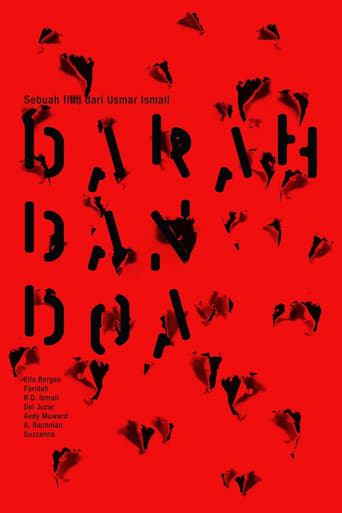
The Long March (1950)
Darah dan Do'a
It tells the story of an Indonesian revolutionary who falls in love with one of his Dutch prisoners.
- Date of release
- 1950-09-30
- TMDB
- 8.0 / 10 (1)
- Runtime
- 2h 8m
- Genres
- War, Drama
- Director
- Usmar Ismail
Casting
- Del Juzar — Kapten Sudarto
- Farida — Widya
- Ella Bergen — Connie
- Sutjipto
- Aedy Moward — Sersan Mula
- Awal
- Johana
- Suzzanna
- Muradi
- Muhsjirsani
- A. Rachman
- R.D. Ismail
Interesting facts
- Filmed in: Indonesia
Darah dan Doa is a 1950 Indonesian war film directed and produced by Usmar Ismail, telling the story of the Siliwangi Division and its leader Captain Sudarto on a march to West Java. Following Ismail's Dutch-produced Tjitra (1949), Darah dan Doa is often cited as the first 'Indonesian' film, and the film's first day of shooting – 30 March – is celebrated in Indonesia as National Film Day.
Production
Darah dan Doa was directed by Usmar Ismail, a former soldier who had previously served as assistant director on Andjar Asmara's Gadis Desa (Village Maiden) and directed two films on his own, Tjitra (Image) and Harta Karun (Treasure; all 1949). Creative control for these works, all of which were produced for the Dutch-sponsored South Pacific Film Corporation (SPFC), was held by cameraman A.A.
Crew for the production consisted of cameraman Max Tera, a former SPFC employee, with makeup by Rancha', artistic design by Basuki Resobowo, G. R. W. Sinsu on music, and Sjawaludin and E. Sambas responsible for the sound effects. Ismail, using his military connections, received technical assistance from various members of the Indonesian Army, particularly Captain Sadono.
Twenty-nine years old, Ismail began shooting on 30 March 1950 in Subang, West Java. The following day he established his own studio, Perfini, to produce the film. Unlike his earlier films, Ismail had severe technical limitations.
Human factors also led to delays in production. Ismail and the other crew members attempted to achieve realism by ensuring everything in the film was as it was in life, a decision which he later recanted after realising that "film was truly the art of make-believe, making people believe something, creating a new reality from what is." Cast-wise, three actors (including the lead, Del Juzar), competed for the affections of Faridah, leading to frict…
During filming, Ismail typed his shooting scripts every night, expanding on the source material. After each day of filming had concluded, Ismail sent the results back to PFN in Jakarta and obtained rush prints which he screened for the cast and crew.
Read on Wikipedia · Text from Wikipedia, CC BY-SA 4.0. Data from Wikidata.
Recommended
- The One That Got Away 1957 · ★ 6.8
- Jacknife 1989 · ★ 6.4
- The War Below 2021 · ★ 6.6
- The Last Rifleman 2023 · ★ 6.6
- Waiting for Anya 2020 · ★ 6.3
- Field of Lost Shoes 2015 · ★ 6.1
- Men in War 1957 · ★ 6.6
- Max 2002 · ★ 6.2
- The Kill Team 2019 · ★ 6.5
- Walking with the Enemy 2014 · ★ 6.3
- One of Our Aircraft Is Missing 1942 · ★ 6.6
- The Boy in the Woods 2023 · ★ 7.0