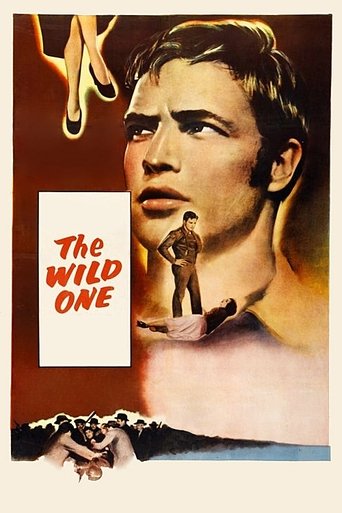
The Wild One (1953)
Hot feelings hit terrifying heights in a story that really boils over!
The Black Rebels Motorcycle Club ride into the small California town of Wrightsville, eager to raise hell. Brooding gang leader Johnny Strabler takes a liking to Kathie, the daughter of the local lawman, as another club rolls into town.
- Date of release
- 1953-12-30
- TMDB
- 6.5 / 10 (347)
- Runtime
- 1h 19m
- Genres
- Drama, Crime, Romance
- Director
- László Benedek
Casting
- Marlon Brando — Johnny Strabler
- Mary Murphy — Kathie Bleeker
- Robert Keith — Sheriff Harry Bleeker
- Lee Marvin — Chino
- Jay C. Flippen — Sheriff Stew Singer
- Peggy Maley — Mildred
- Hugh Sanders — Charlie Thomas
- Ray Teal — Frank Bleeker
- John Brown — Bill Hannegan
- Will Wright — Art Kleiner
- Robert Osterloh — Ben
- William Vedder — Jimmy
Interesting facts
The Wild One is a 1953 American crime film directed by László Benedek and produced by Stanley Kramer. The picture is most noted for the character of Johnny Strabler, portrayed by Marlon Brando, whose persona became a cultural icon of the 1950s. The Wild One is considered to be the original outlaw biker film, and the first to examine American outlaw motorcycle gang violence. The supporting cast features Lee Marvin as Chino, truculent leader of the motorcycle gang "The Beetles".
Production
The main differences between the screenplay and Frank Rooney's source story, "Cyclists' Raid", were that there were no rival gangs nor any romance between Kathie and any of the motorcyclists, and indeed she is the victim of the fatal motorcycle accident. Unlike in the film, it is her father (who is not a policeman) who exacts violent revenge upon an innocent young motorcyclist.
Brando later revealed in his autobiography, Songs My Mother Taught Me (1994 Random House), that "(m)ore than most parts I've played in the movies or onstage, I related to Johnny, and because of this, I believe I played him as more sensitive and sympathetic than the script envisioned. There's a line where he snarls, 'Nobody tells me what to do'.
The technical advisor on the film was identified in the April 1953 issue of Motorcyclist as Carey Loftin, which also noted that 150 motorcyclists were hired as extras.
Filming mainly took place at the Columbia Pictures Ranch, "Western Street 'A'", which was re-dressed to depict a 1950s Midwest American town with the dirt paths covered in asphalt.
The sharpness of the film photography was achieved with a Garutso lens, according to Halliwell's Filmgoers Companion.
Read on Wikipedia · Text from Wikipedia, CC BY-SA 4.0. Data from Wikidata.
Recommended
- The Parts You Lose 2019 · ★ 6.6
- Killer's Kiss 1955 · ★ 6.3
- The Newton Boys 1998 · ★ 6.1
- The Quiller Memorandum 1966 · ★ 5.9
- North Shore 1987 · ★ 5.9
- Purple Hearts 2022 · ★ 8.0
- Moonlight Mile 2002 · ★ 6.3
- A Talent for Murder 2026 · ★ 7.2
- Thieves Like Us 1974 · ★ 6.5
- Winter's Tale 2014 · ★ 6.3
- Little Caesar 1931 · ★ 6.9
- House of Strangers 1949 · ★ 7.0