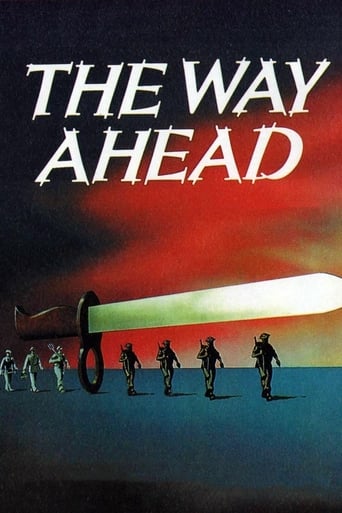
Hacia adelante (1944)
The Way Ahead
Listos para luchar y morir por su país, un grupo de civiles de toda clase y condición se someten a un entrenamiento básico ante el inminente estallido de la Segunda Guerra Mundial (1939-1945). Aunque al principio se quejan de la rígida disciplina que implica su nuevo régimen de vida, no tardan en adaptarse y adquirir las habilidades necesarias para cumplir con su cometido, además de sentirse orgullosos de ello. Durante su participación en la invasión del norte de África, su barco será alcanzado por los alemanes. (FILMAFFINITY)
- Fecha de estreno
- 1944-06-09
- TMDB
- 6.5 / 10 (42)
- Duración
- 1 h 55 min
- Géneros
- Drama, Bélica
- Director
- Carol Reed
Reparto
- David Niven — Lieutenant Jim Perry
- Stanley Holloway — Pvt. Ted Brewer
- James Donald — Pvt. Evans Lloyd
- John Laurie — Pvt. Luke
- Leslie Dwyer — Pvt. Sid Beck
- Hugh Burden — Pvt. Bill Parsons
- Raymond Huntley — Pvt. Herbert Davenport
- Jimmy Hanley — Pvt. Geoffrey Stainer
- William Hartnell — Sgt. Ned Fletcher
- Reginald Tate — The Training Company Commanding Officer
- Leo Genn — Captain Edwards
- John Ruddock — Old Chelsea Soldier
Curiosidades
- Premios: 1 · Nominaciones: 0. Incluyendo: National Board of Review a las 10 Películas más Destacadas
The Way Ahead (1944) is a British Second World War drama film directed by Carol Reed. The screenplay was written by Eric Ambler and Peter Ustinov. The film stars David Niven, Stanley Holloway and William Hartnell along with an ensemble cast of other British actors, including Ustinov in one of his earliest roles. The Way Ahead follows a group of civilians who are conscripted into the British Army and, after training, are shipped to North Africa where they are involved in a battle against the Afrika Korps.
Production
The Way Ahead was written by Eric Ambler and Peter Ustinov, and directed by Carol Reed. The three had originally produced the 1943 44-minute training film The New Lot, which was produced for the Army Kinematograph Service. The Way Ahead was an expanded remake of their earlier film, this time intended for a commercial audience.
The driving force behind the film was David Niven, a 1930 graduate of Sandhurst, who at the time was a major in the British Army working with the Army Film Unit and later served in Normandy with GHQ Liaison Regiment. Niven was the executive producer on The Way Ahead.
The last scene in The Way Ahead shows the soldiers advancing in a counter-attack. Instead of the film ending with the words "The End", it concludes with "The Beginning". In a film made and released during the war, this was an effort to galvanise public support for the final push in the war effort, with a perhaps not unintended reference to one of Winston Churchill's famous quotations: "This is not the end.
Peter Ustinov wrote of sailing to North Africa with Carol Reed where footage of the Platoon in Algeria was filmed at Philippeville (now Skikda). The minaret of the town's Mosquée de Sidi Ali Dib is clearly visible as Bren carriers drive through the streets.
In the United States, an edited version of The Way Ahead, with an introduction by journalist Quentin Reynolds, was released as Immortal Battalion.
Leer en Wikipedia · Texto de Wikipedia, CC BY-SA 4.0. Datos de Wikidata.
Recomendadas
- El proceso de Billy Mitchell 1955 · ★ 6.8
- Waiting for Anya 2020 · ★ 6.3
- The War Below 2021 · ★ 6.6
- El último soldado 2023 · ★ 6.6
- La sombra de un gigante 1966 · ★ 6.3
- El único evadido 1957 · ★ 6.8
- Overlord 1975 · ★ 6.8
- También somos seres humanos 1945 · ★ 6.5
- A bayoneta calada 1951 · ★ 6.5
- Fort Bliss 2014 · ★ 6.4
- Las cuatro plumas 1939 · ★ 7.1
- La brigada del diablo 1968 · ★ 6.3