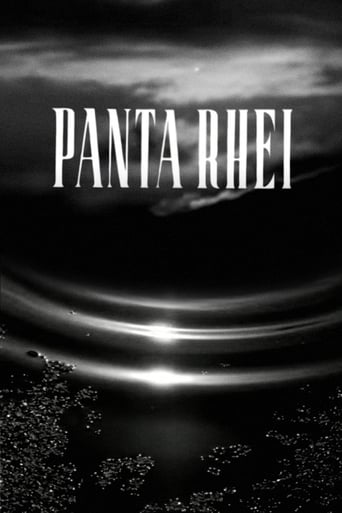
Panta Rhei (1952)
All things flow.
In 1952, Haanstra made Panta Rhei , another view of Holland through the eyes of a painter and filmmaker. Its poetic images of water, skies and clouds reflect Haanstra's own moods.
- Date of release
- 1952-03-08
- TMDB
- 6.4 / 10 (10)
- Runtime
- 10m
- Genres
- Documentary
- Director
- Bert Haanstra
Interesting facts
Panta Rhei is a Dutch short documentary film by Bert Haanstra, first shown in 1952. It portrays the motions of nature, edited rhythmically with alternating footage of water, clouds and vegetation, sometimes using time-lapse photography. It was Haanstra's fourth film as director and like many of his early films it does not feature any humans. The title is a Greek phrase associated with the philosopher Heraclitus and the concept that everything is in a constant state of becoming something else. The film competed at the 1952 Cannes Film Festival. Critics have highlighted its rhythmicality and vision of nature.
Production
Panta Rhei was the fourth film Bert Haanstra directed and it was made right after his film Mirror of Holland had won the Short Film Grand Prix at the 1951 Cannes Film Festival. Like several of Haanstra's early films, it is based on rhythms, patterns and associations. Haanstra later explained this by saying he was not yet ready to cope with humans. Haanstra was the writer, director, cinematographer and editor of Panta Rhei.
The title is the Greek phrase panta rhei which means "everything flows". It comes from Plato's dialogue Cratylus where it is associated with the philosopher Heraclitus. Haanstra did not study Heraclitus' philosophy but was fascinated by the concept that everything continuously becomes something else.
The soundtrack consists of a modernist chamber music score by Max Vredenburg. The music involves a harp arpeggio when water reflects the sun, a solo flute and bassoon lines accompanying natural sounds, an oboe motif to footage of opening flowers and a harpsichord ostinato during close-ups of streaming water.
Read on Wikipedia · Text from Wikipedia, CC BY-SA 4.0. Data from Wikidata.
Recommended
- Fuck 2006 · ★ 6.4
- Come See Me in the Good Light 2025 · ★ 7.1
- Naqoyqatsi 2002 · ★ 6.2
- McQueen 2018 · ★ 7.4
- Powaqqatsi 1988 · ★ 7.2
- 42 Up 1999 · ★ 7.6
- In the Realms of the Unreal 2004 · ★ 7.2
- As I Was Moving Ahead Occasionally I Saw Brief Glimpses of Beauty 2000 · ★ 7.8
- American Teen 2008 · ★ 6.4
- Aquaman: Heroines of Atlantis 2019 · ★ 6.2
- Koyaanisqatsi 1983 · ★ 7.9
- Sherman's March 1986 · ★ 6.3