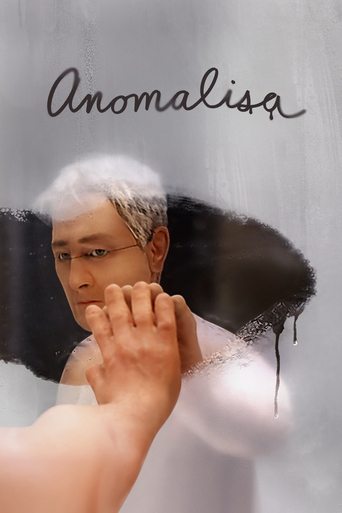
Anomalisa (2015)
An inspirational speaker becomes reinvigorated after meeting a lively woman who shakes up his mundane existence.
- Date of release
- 2015-12-30
- TMDB
- 7.1 / 10 (1901)
- Runtime
- 1h 31m
- Genres
- Animation, Drama, Romance, Comedy
- Director
- Charlie Kaufman, Duke Johnson
Casting
- David Thewlis — Michael Stone (voice)
- Jennifer Jason Leigh — Lisa Hesselman (voice)
- Tom Noonan — Everyone Else (voice)
Interesting facts
- Awards: 1 · Nominations: 4. Including: Grand Jury Prize of the Venice Film Festival
Anomalisa is a 2015 American adult animated comedy-drama film directed by Charlie Kaufman and Duke Johnson from a screenplay by Kaufman, based on his 2005 audio play that explores the Fregoli delusion, a term Kaufman used as a pen name for himself. It incorporates elements of psychological drama, romantic comedy, and self-reflexive fiction in surrealist style, in a similar vein as Eternal Sunshine of the Spotless Mind, whose screenplay Kaufman penned. Anomalisa follows the British middle-aged customer service expert Michael Stone, who perceives everyone as identical except for Lisa Hesselman, whom he meets in a Cincinnati hotel.
Production
The first version of Anomalisa was written and performed in 2005 for the Los Angeles run of "Theater of the New Ear", described as "a concert for music and text, or a set of 'sound plays'" by Carter Burwell, who commissioned and scored them. It was a double bill with Kaufman's Hope Leaves the Theater, and replaced Sawbones, by the Coen Brothers, from the earlier New York run, after that play's actors were unavailable.
Kaufman was initially opposed to turning the play into an animated film, saying that the play had "a disconnect between what's being said on stage and what the audience is seeing – there's Tom playing all these characters, there's Jennifer and David having sex while they're really just standing across the stage from each other and moaning. You'd lose that".
The film's production company, Starburns Industries, sought funding on Kickstarter to "produce this unique and beautiful film outside of the typical Hollywood studio system," where the company believed the film would be inevitably changed from its initial conception. Initially pitched as a short film "approximately 40 minutes in length", the team set a funding goal of $200,000.
The puppets were created with 3D printers, with multiple copies of each character. Eighteen Michaels and six Lisas were created. Johnson recounted that the team was told that such realistic puppets would be "disturbing and off-putting", but disagreed, saying that the nature of stop-motion film, with human hands moving puppets for each frame, brought "organic life" to the medium.
Kaufman and Johnson have described the process of stop-motion animation as "laborious" and found challenges in making the puppets look lifelike and relatable. Animator Dan Driscoll said they found people on whom to model the puppets, studied human movement and facial expressions to produce a precise result, created the puppets and built the sets, and finally placed the puppets on the sets and moved them frame by frame to create the illusion of mo…
Read on Wikipedia · Text from Wikipedia, CC BY-SA 4.0. Data from Wikidata.
Recommended
- Heavy Traffic 1973 · ★ 6.5
- Waking Life 2001 · ★ 7.5
- Entergalactic 2022 · ★ 7.7
- All of You 2025 · ★ 6.3
- Blue Valentine 2010 · ★ 7.0
- Coonskin 1975 · ★ 6.1
- Still Breathing 1997 · ★ 6.5
- Fixed 2025 · ★ 6.2
- Ode to Joy 2019 · ★ 6.1
- Stealing Beauty 1996 · ★ 6.7
- Bros 2022 · ★ 6.6
- $9.99 2009 · ★ 5.9