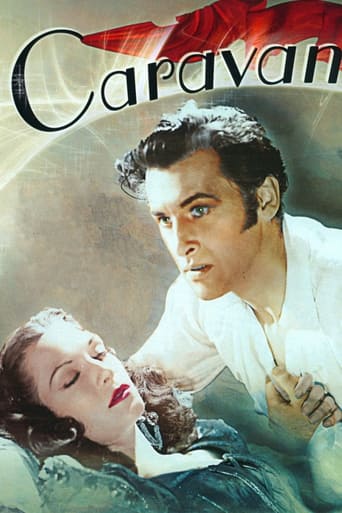
Caravan (1946)
The Great New Lover of the Screen!
During the last half of the 19th century writer Richard Darrell saves Don Carlos from two robbers, and is entrusted by Don Carlos to take a valuable necklace to Spain. Richard leaves his fiancé, Oriana, and starts the trip. He meets Wycroft, a henchman for Sir Francis Castteldow, an aristocrat out to steal Oriana from Richard. The latter is assaulted, robbed and nearly killed and, as a result, loses his memory. He marries a gypsy girl, Rosal, while Oriana, thinking him dead marries the dastardly Sir Francis. Everybody will meet again. Complications will arise.
- Date of release
- 1946-06-03
- TMDB
- 6.7 / 10 (6)
- Runtime
- 1h 57m
- Genres
- Romance, Adventure, Drama
- Director
- Arthur Crabtree
Casting
- Stewart Granger — Richard Darrell
- Jean Kent — Rosal
- Anne Crawford — Oriana Camperdene
- Dennis Price — Sir Francis Castleton
- Robert Helpmann — Wycroft
- Gerard Heinz — Don Carlos
- Enid Stamp-Taylor — Bertha (as Enid Stamp Taylor)
- David Horne — Camperdene
- John Salew — Diego
- Arthur Goullet — Suiza
- Julian Somers — Manoel
- Pete Murray — Juan (as Peter Murray)
Interesting facts
Caravan is a 1946 British black-and-white drama film directed by Arthur Crabtree. It was one of the Gainsborough melodramas and is based on the 1942 novel Caravan by Eleanor Smith.
Production
The film was based on a novel by Eleanor Smith which was published in 1943. It was one of several novels by Smith to feature gypsies. Film rights were purchased by Gainsborough Pictures who had enjoyed success during the war with a series of melodramatic movies, starting with The Man in Grey (1943), also based on a novel by Smith.
The film's four leads were all under contract to Gainsborough and were well known for appearing in melodramas at the studio. Stewart Granger and Jean Kent had previously appeared together in Fanny By Gaslight and Madonna of the Seven Moons, and Anne Crawford who had been in They Were Sisters.
The film was meant to follow The Magic Bow, but that was postponed due to the illness of Phyllis Calvert so, Caravan had to be rushed into production. Filming began in June 1945 on location in North Wales, with Snowdon standing in for Spain. The unit then transferred to Gainsborough's studios at Shepherd's Bush in London. Jean Kent met her future husband during the making of the movie.
Read on Wikipedia · Text from Wikipedia, CC BY-SA 4.0. Data from Wikidata.
Recommended
- Supercross 2005 · ★ 6.3
- Sahara 1983 · ★ 5.9
- The Secret: Dare to Dream 2020 · ★ 7.4
- Peter Ibbetson 1935 · ★ 7.0
- The Lost Husband 2020 · ★ 6.7
- Strange Cargo 1940 · ★ 7.0
- Elephant Walk 1954 · ★ 5.9
- Departure 2016 · ★ 6.3
- A Valentine's Match 2020 · ★ 7.0
- The Sheik 1921 · ★ 5.9
- The Age of Adaline 2015 · ★ 7.5
- Fallen Angel 1945 · ★ 6.6