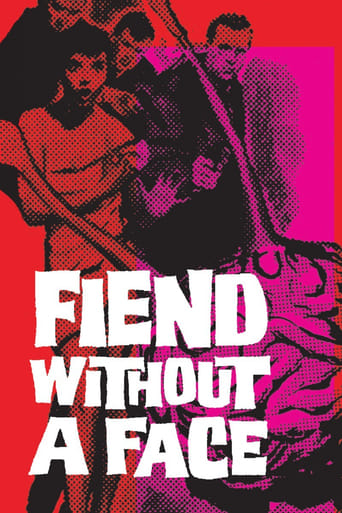
Fiend Without a Face (1958)
New Horrors! Mad Science Spawns Evil Fiends! ... Taking form before your horrified eyes!
An American airbase in Canada provokes resentment from the nearby residents after fallout from nuclear experiments at the base are blamed for a recent spate of disappearances. A captain from the airbase is assigned to investigate, and begins to suspect that an elderly British scientist who lives near the base and conducts research in the field of mind over matter knows more than he is letting on..
- Date of release
- 1958-07-03
- TMDB
- 6.0 / 10 (95)
- Runtime
- 1h 14m
- Genres
- Horror, Science Fiction
- Director
- Arthur Crabtree
Casting
- Marshall Thompson — Major Jeff Cummings
- Kynaston Reeves — Prof. R. E. Walgate
- Kim Parker — Barbara Griselle
- Stanley Maxted — Col. Butler
- Terry Kilburn — Capt. Al Chester
- James Dyrenforth — Mayor Hawkins
- Robert MacKenzie — Const. Howard Gibbons
- Peter Madden — Dr. Bradley
- Gil Winfield — Dr. Warren
- Michael Balfour — Sgt. Kasper
- Launce Maraschal — Melville
- Meadows White — Ben Adams
Interesting facts
Fiend Without a Face is a 1958 British science-fiction horror film directed by Arthur Crabtree and starring Marshall Thompson, Kynaston Reeves, Kim Parker, and Stanley Maxted in his final film role. The screenplay by Herbert J. Leder is based on Amelia Reynolds Long's short story "The Thought Monster", originally published in the March 1930 issue of Weird Tales magazine.
Production
Noted science fiction personality, collector, and literary agent Forrest J Ackerman represented mystery and science fiction pulp writer Long and brokered the sale of her story "The Thought Monster" to the film's producers. New York-based British producer and distributor Richard Gordon bought the film rights, and produced the film through his London company Amalgamated Productions, which he co-owned with former Rank executive John Croydon.
Screenwriter Leder was originally set to direct the film, but being American, was unable to obtain a British work permit in time, so Crabtree replaced him as director. Thompson later said that when the director showed up on the first day of shooting and looked at the script, Crabtree claimed it was not the film he had been hired to direct, as he did not do "monster" films.
Fiend Without a Face was made entirely in England. Its Canadian setting was chosen because it would appeal to both American and British Commonwealth movie audiences, while still being easy to replicate using the English shooting locations. U. S. Air Force stock aviation footage was also used to establish the military base setting and to pad out the film's meager running time.
The film's visible brain creatures were created using stop-motion animation, an unusual practice for such a low-budget science fiction thriller of this era. The director of these effects sequences was Florenz "Flo" von Nordoff, while the actual stop-motion was done in Munich by Nordhoff's partner, West German special effects artist Karl Ludwig Ruppel. Peter Neilson headed up the British practical effects crew.
Read on Wikipedia · Text from Wikipedia, CC BY-SA 4.0. Data from Wikidata.
Recommended
- The Brood 1979 · ★ 6.7
- Extinction 2015 · ★ 6.4
- Elevation 2024 · ★ 6.4
- I Am Mother 2019 · ★ 6.7
- The Last House 2026 · ★ 6.8
- Open Grave 2013 · ★ 6.0
- The Crazies 1973 · ★ 6.1
- Malignant 2021 · ★ 6.7
- Twelve Monkeys 1995 · ★ 7.6
- Die Alone 2024 · ★ 6.4
- Arcadian 2024 · ★ 6.0
- Resident Evil 2002 · ★ 6.7