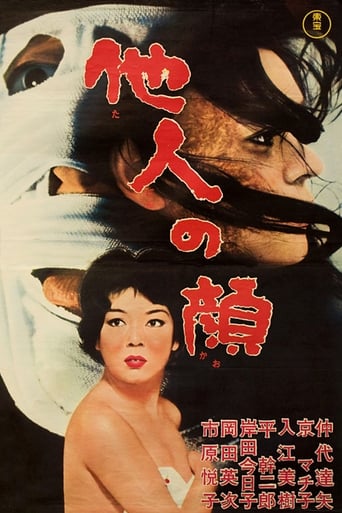
타인의 얼굴 (1966)
他人の顔
신설 공장을 점검하던 중 실수로 얼굴에 큰 화상을 입은 오쿠야마는 얼굴을 잃게 되고, 아내와 동업자인 전무, 비서들과의 대인 관계도 잃었다고 생각한다. 얼굴을 완전히 바꾸어 자신의 아내를 유혹하기로 결심한 그는 정신과 의사를 찾아간다. 의사는 오쿠야마에게 모든 행동을 보고 한다는 조건으로 가면을 만들어 주는데... 이베 코보의 동명 소설을 1960년대 당시 새롭게 떠오르던 감독 테시가하라 히로시가 영화화한 작품. 얼굴에 큰 화상을 입고 얼굴을 잃은 후 모든 것을 잃었다고 생각하게 된 한 남자가 ‘타인의 얼굴’을 지니게 되면서 겪게 되는 심리적 변화와 그를 통해 ‘얼굴’이 상징하는 개인의 정체성에 관한 문제를 다룬 작품이다. 인간의 온갖 장기로 가득한 병원의 초현실적이면서 기이한 풍경, 얼굴을 스스로의 정체성이라 믿으며 그것을 주변 사람들과 부인에게 시험해보려는 남자의 욕망과 좌절 등 왜곡된 인긴 심리를 우울하고 어둡게 묘사했다. 일본 영화음악계의 거장 타케미츠 토오루의 음악 역시 영화의 어두운 분위기를 잘 살려내고 있다.
출연진
- 나카다이 타츠야 — Mr. Okuyama
- 히라 미키지로 — Dr. Hori
- 쿄 마치코 — Mrs. Okuyama
- 키시다 쿄코 — Nurse
- 岡田英次 — The Boss
- 入江美樹 — Scarred Girl
- Kakuya Saeki — Elder Brother of Scarred Girl
- 치아키 미노루 — Apartment Superintendent
- 이치하라 에츠코 — Yoko
- 이가와 히사시 — Man with Mole
- 観世栄夫 — Male Patient
- 田中邦衛 — Mentally Ill Man #1
흥미로운 사실
- 원작: 타인의 얼굴
The Face of Another is a 1966 Japanese New Wave film directed by Hiroshi Teshigahara and based on the 1964 novel of the same name written by Kōbō Abe. The story follows engineer Okuyama, who suffers severe facial burns in a work-related accident and is given a new face in the form of a lifelike mask.
Production
One recurring image is the large and small severed ears which appear in the scenery in several scenes. These ears were designed and sculpted by Japanese sculptor Tomio Miki.
Hira's office, a strange blank space with glass partitions, was designed by architect Arata Isozaki, a friend of Teshigahara's. The glass walls are painted with Langer's lines and Leonardo da Vinci's Vitruvian Man.
The film uses several doublings of shots, both by repeating shots verbatim and by placing the main character in nearly identical shots twice. The most obvious example is in Okuyama's two separate rentals of apartments, once masked, and once with his new face. These doublings highlight Okuyama's double existence.
위키백과에서 더 읽기 · 텍스트 출처: 위키백과, CC BY-SA 4.0. 데이터 출처: Wikidata.
추천
- 신 가면라이더 2023 · ★ 6.9
- 스파이더맨 2 2004 · ★ 7.3
- 조나단 2018 · ★ 5.9
- 용의자 X의 헌신 2008 · ★ 7.6
- 가시나무 왕 2010 · ★ 6.6
- 스페이스 타임 2025 · ★ 5.8
- 1984 1956 · ★ 6.5
- 공각기동대 신극장판 2015 · ★ 6.6
- 트론: 새로운 시작 2010 · ★ 6.6
- 거울 속 외딴 성 2022 · ★ 7.1
- 닥터 스트레인지 2007 · ★ 6.7
- 데스노트 L: 새로운 시작 2008 · ★ 6.0