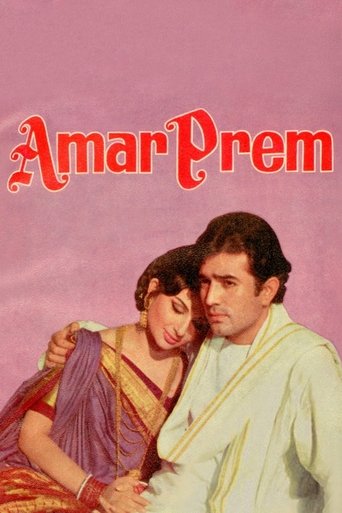
अमर प्रेम (1972)
A village woman abandoned by her husband is forced into prostitution in Kolkata and forms nameless yet strong relations with a wealthy patron as well as an abused boy in the neighbourhood.
- Data lansării
- 1972-01-28
- TMDB
- 7.0 / 10 (18)
- Durată
- 2 h 23 min
- Genuri
- Dramă, Romantic
- Regizor
- Shakti Samanta
Distribuție
- Sharmila Tagore — Pushpa
- Rajesh Khanna — Anand Babu
- Madan Puri — Nepal Babu
- Sujit Kumar — Mahesh
- Vinod Mehra — Nand Kishore Sharma / Nandu
- Leela Mishra — Mausi
- Satyendra Kapoor — Vijay
- Ram Mohan — Shankar
- Bindu Desai — Kamla
- Om Prakash — Natwarlal
- Man Mohan — Pushpa's Husband
- Abhi Bhattacharya — Doctor
Curiozități
Amar Prem is a 1972 Indian Hindi romantic drama film directed by Shakti Samanta. It is a remake of the Bengali film Nishi Padma (1970), directed by Arabinda Mukherjee, who wrote screenplay for both the films based on the Bengali short story Hinger Kochuri by Bibhutibhushan Bandopadhyay. The film portrays the decline of human values and relationships and contrasts it by presenting an illustrious example of a boy's innocent love for a neighbourhood tawaif. The movie is about a school boy, who is ill-treated by his step mother, and becomes friends with a tawaif neighbour.
Production
After making entertainers like China Town (1962), Ek Raaz (1963), Kashmir Ki Kali (1964), Sawan Ki Ghata (1966) and An Evening in Paris (1967) through the 1960s, with Aradhana (1969) and Kati Patang (1971), Samanta had entered the phase of emotional dramas in his career. Nishi Padma (Night Flower, 1970), for night-flowering-jasmine, was made by Arabinda Mukherjee with Uttam Kumar and Sabitri Chatterjee as leads.
The story was first published in Bandopadhyay's short story collection, Galpa Panchashat (Fifty Stories, 1956). His stories had previously been adapted by Satyajit Ray as Pather Panchali (1955) and the Apu Trilogy. Shakti Samanta asked Mukherjee who also wrote Nishi Padma's screenplay to write a Hindi version, with Ramesh Pant, a longtime-collaborator with Samanta penning the Hindi dialogues.
Once the script was ready, Samanta approached Sharmila Tagore, with whom he had done a string of films, like Kashmir Ki Kali (1964), An Evening in Paris (1967) and most recently Aradhana (1969), with Rajesh Khanna. Tagore found her character "Pushpa", "a very strong role in the iconic mould of Mother India" and instantly agreed, thus it was one of the first films she signed on after the birth of her son Saif Ali Khan.
The film was shot in Eastmancolor, entirely at Natraj Studios in Mumbai, including the famous song, Chingari koi bhadke, which was set on a boat on the Hooghly River, with Howrah Bridge of Kolkata in the background. Earlier authorities in Kolkata didn't give the film crew permission to shoot under the bridge, as it would be a crowd problem. Thus the song was shot in a water tank in the studio, with the crew filming in knee-deep water.
Citește pe Wikipedia · Text din Wikipedia, CC BY-SA 4.0. Date din Wikidata.
Recomandate
- Not Easily Broken 2009 · ★ 6.3
- Dhadkan 2000 · ★ 6.4
- Nouă vieți 2005 · ★ 6.1
- E suficientă iubirea, domnule? 2018 · ★ 7.1
- Nobody Has to Know 2022 · ★ 6.7
- Atât timp cât voi trăi 2012 · ★ 7.0
- The Magic of Ordinary Days 2005 · ★ 7.5
- Love Everlasting 2016 · ★ 7.4
- Secretul: Îndrăznește să visezi 2020 · ★ 7.4
- Viața într-un an 2020 · ★ 8.2
- Dragoste pe bune 2020 · ★ 6.3
- Ali and Nino 2016 · ★ 6.5