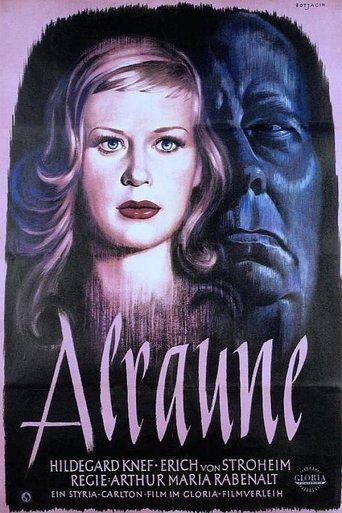
Alraune (1952)
In the 1800s, a stormy love relationship develops quickly between a young medical student and a woman believing herself to be the daughter of his scientist uncle, the student having never heard of her before their chance encounter and both unaware that she is the result of the scientist's illegal experiments with artificial insemination..
- Fecha de estreno
- 1952-10-22
- TMDB
- 5.5 / 10 (20)
- Duración
- 1 h 32 min
- Géneros
- Drama, Ciencia ficción, Romance, Terror
- Director
- Arthur Maria Rabenalt
Reparto
- Hildegard Knef — Alraune
- Erich von Stroheim — Jacob ten Brinken
- Karlheinz Böhm — Frank Braun
- Harry Halm — Doctor Mohn
- Hans Cossy — Mathieu
- Harry Meyen — Count Geroldingen
- Trude Hesterberg — Gräfin Wolkonska
- Julia Koschka — Olga Wolkonska
- Denise Vernac — Mlle. Duvaliere
- Gardy Brombacher — Lisbeth
- Willem Holsboer
- Arno Ebert
Curiosidades
- Basada en: Alraune
Alraune, later renamed Unnatural: The Fruit of Evil, is a 1952 West German horror science fiction film, directed by Arthur Maria Rabenalt and starring Hildegard Knef and Erich von Stroheim. The film is based on the 1911 novel Alraune by German novelist Hanns Heinz Ewers. The plot involves a scientist who creates a woman (Knef) who is beautiful yet soulless, lacking any sense of morality.
Production
In an Interview given back in February 1989 he stated how his involvement begin with "Carlton was Stapenhorst, and then there was an Austrian producer who made his money primarily from petrol stations and was a very stubborn, mindless, peasant person. He had a contract with Knef and, according to his idea, Knef should be The Mandrake after The Sinner (1951) and Erich von Stroheim the genius-crazy scientist."
Even from its earliest stage, Alraune was stirring controversy. Just the announcement "Erich von Stroheim and Hildegard Knef in Alraune" led to a scandal. The church pulpits were spoken against the film, against the topic of artificial insemination; at that time the church had a great influence on cultural politics. Stapenhorst was happy about the advertisement, but he also feared the power of the church.
At the time the cast was considered to be 'All-star", even more so as Eric von Stroheim was respectfully known as "one of the great silent film director", who had all but retired from acting by the time Alraune was to begin filming. Hildegard Knef had also achieved fame in both her native country Germany and international fame.
Alraune is rooted from an actual plant Mandrake, which is German for mandragora. While the book stays relatively faithful to the book, unlike the 1928 film, there is a shot in the film which depicts Alraune's wide eyed face fades out of focus into the grotesque version of a mandrake. The plant is deeply-rooted in German literature and folklore.
The film's soundtrack and music was composed by Werner Richard Heymann, who had a well known career in the German industry and Hollywood. The only two songs on the soundtrack were sung by Hildegard Knef, with the songs "Heut' gefall' ich mir" and "Das Lied vom einsamen Mädchen" written by lyricist Robert Gilbert. The sound team consisted of Heinz Terworth and Klang-Film Eurocord.
Leer en Wikipedia · Texto de Wikipedia, CC BY-SA 4.0. Datos de Wikidata.
Recomendadas
- Equals 2015 · ★ 6.1
- Nunca me abandones 2010 · ★ 6.8
- La luz de mi vida 2019 · ★ 6.5
- Doctor Zhivago 1965 · ★ 7.6
- Un espacio entre nosotros 2017 · ★ 7.0
- Las vidas posibles de Mr. Nobody 2009 · ★ 7.8
- Separados por accidente 2009 · ★ 6.3
- La fuente de la vida 2006 · ★ 6.9
- Cuento de invierno 2014 · ★ 6.3
- La sangre del vampiro 1958 · ★ 5.8
- Jonathan 2018 · ★ 5.9
- El origen del planeta de los simios 2011 · ★ 7.4