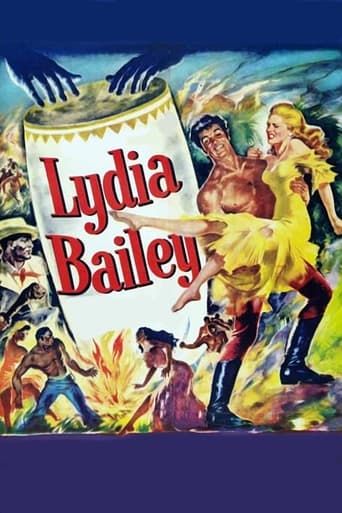
Lydia Bailey (1952)
Lydia Bailey ... is Haiti, Voodoo and Passion !
A young Boston lawyer, Albron Hamlin, goes to Haiti in 1802 to find Lydia Bailey, whose estate he must settle. The island is war-torn in the strife between Toussaing L'Overture, the black president, and the French who are trying to retake possession of the country. Hamlin finds Lydia and, against the background of war and rebellion, they fall in love while helping the Haitians against the French.
- Date of release
- 1952-05-30
- TMDB
- 6.8 / 10 (6)
- Runtime
- 1h 29m
- Genres
- History, Adventure
- Director
- Jean Negulesco
Casting
- Dale Robertson — Albion Hamlin
- Anne Francis — Lydia Bailey
- Charles Korvin — Col. Gabriel D'autremont
- William Marshall — King Dick
- Luis van Rooten — General Charles LeClerc
- Angos Perez — Paul d'Autremont
- Robert Evans — Soldier
- Roy Glenn — Mirabeau
- Bill Walker — General LaPlume
- Rosalind Hayes — Aspodelle
- Juanita Moore — Marie (uncredited)
- Gladys Holland — Pauline Bonaparte (uncredited)
Interesting facts
Lydia Bailey is a 1952 American historical adventure film directed by Jean Negulesco and starring Dale Robertson, Anne Francis and Charles Korvin. The screenplay is based on the 1947 novel of the same name by Kenneth Roberts.
Production
Kenneth Roberts wrote the bestselling 1947 novel Lydia Bailey, which The New York Times called "an entertaining chronicle" with a "preposterous plot". Twentieth Century-Fox first obtained the screen rights in September 1946 before the book was published, paying $215,000 for a ten-year period of rights. Fox representatives admitted that they had not even read the book and had based their purchase solely on Roberts' reputation and an outline.
After the British government introduced a tax on Hollywood films, Twentieth Century-Fox delayed production of high-budget films for which profits in the British market would be essential. This included Lydia Bailey, The Black Rose, Julie and Down to the Sea in Ships.
In April 1948, the project was reactivated with plans to finance the film using frozen funds owed to Fox in England and the Bahamas. In June, Fox announced that Philip Dunne was writing a screenplay and that Linda Darnell would likely play the title role. However, further delays ensued. By May 1949, Susan Hayward was mentioned as a possibility for the lead female role. In September, Zanuck said that the film would soon enter production.
In February 1950, Fox announced Tyrone Power as the male lead. In November, Jules Shernberg was appointed producer and Micheline Prelle was announced as the star. In June 1951, Power refused the role, as he had appeared in five consecutive historical-period films.
Errol Flynn accused Canadian millionaire Duncan McMartin of slapping him in a bar, aggravating a spinal injury that prevented him from appearing in the film. He sued McMartin in the Bahamas Supreme Court for £80,000, which included his reported fee for Lydia Bailey, $200,000. The court awarded Flynn $14,000 in damages.
Read on Wikipedia · Text from Wikipedia, CC BY-SA 4.0. Data from Wikidata.
Recommended
- Kings of the Sun 1963 · ★ 6.1
- Treasure Island 1950 · ★ 6.5
- Tarzan & Jane 2002 · ★ 6.0
- Under the Boardwalk 2023 · ★ 7.3
- Muppet Treasure Island 1996 · ★ 6.7
- The Guns of Navarone 1961 · ★ 7.3
- Johnny English Strikes Again 2018 · ★ 6.3
- White Fang 2: Myth of the White Wolf 1994 · ★ 6.9
- Scaramouche 1952 · ★ 7.0
- Treasure Island 1972 · ★ 5.9
- Journey 2: The Mysterious Island 2012 · ★ 6.2
- H.M.S. Defiant 1962 · ★ 6.6