Dörfer in Flammen (1996)
Лепа села лепо горе
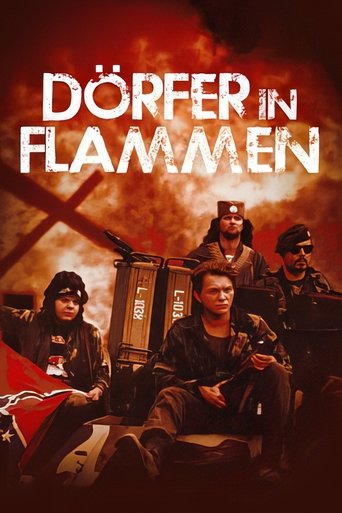
Der Bosnienkrieg: Eine Truppe serbischer Soldaten sucht auf der Flucht vor einem Angriff nach Schutz und landet in einem alten verlassenem Tunnel. Die islamische feindliche Einheit versteckt sich auf dem Tunneldach und lässt keinen da raus. Sie wollen sie langsam verhungern und verdursten lassen. Dies ist die Hauptrückblende von vielen Erinnerungen und Alpträumen unseres Hauptprotagonisten Milan, welcher nach dem Krieg im Krankenhaus liegt und sich zurückerinnert. Von seiner Kindheit und Schulzeit mit dem muslimischen besten Freund Halil, bis zu der gemeinsamen eröffnung einer Autowerkstatt und dem grausamen aufeinandertreffen beim Tunnel...
- Erscheinungsdatum
- 1996-05-11
- TMDB
- 7.9 / 10 (115)
- Laufzeit
- 1 Std. 55 Min.
- Genres
- Drama, Kriegsfilm
- Regie
- Srđan Dragojević
Besetzung
- Dragan Bjelogrlić — Milan
- Nikola Kojo — Velja
- Dragan Maksimović — Petar, profesor
- Zoran Cvijanović — Brzi
- Milorad Mandić — Viljuška
- Dragan Petrović 'Pele' — Laza
- Lisa Moncure — Liza
- Nikola Pejaković — Halil
- Velimir Živojinović — Gvozden
- Petar Božović — Sloba
- Marko Kovijanić — Marko
- Dragan Zarić — Nazim
Wissenswertes
- Auszeichnungen: 0 · Nominierungen: 1
Pretty Village, Pretty Flame is a 1996 Serbian film directed by Srđan Dragojević with a screenplay based on a book written by Vanja Bulić.
Production
The funds for the movie were raised through Cobra Film Department, a legal entity that was registered as a limited liability company by Nikola Kojo, Dragan Bjelogrlić, Goran Bjelogrlić, and Milko Josifov. Most of the money came from the Serbian government's (under prime minister Mirko Marjanović) Ministry of Culture (headed by cabinet minister Nada Perišić-Popović) as well as from the Serbian state television RTS.
The shooting of the film under the working title Tunel began on 19 April 1995. The majority of the scenes were shot on locations in and around Višegrad, Republika Srpska (Serb inhabited entity of Bosnia and Herzegovina, still governed by Radovan Karadžić) at the time, often in places that were former battlefields.
According to Dragojević, the movie's title is paraphrased from a passage describing burning villages in the distance in Louis-Ferdinand Céline's 1932 novel Voyage au bout de la nuit, a literary work that had a strong impact on Dragojević when he read it in his early youth.
Auf Wikipedia weiterlesen · Text aus Wikipedia, CC BY-SA 4.0. Daten aus Wikidata.
Empfohlen
- Quo Vadis, Aida? 2021 · ★ 7.6
- The War Below 2021 · ★ 6.6
- Enklave 2015 · ★ 7.2
- Nur ein einziges Leben 2020 · ★ 6.3
- Ararat 2002 · ★ 6.1
- Helden von Hill 60 2010 · ★ 6.8
- North & South - Die Schlacht bei New Market 2015 · ★ 6.1
- Tag ohne Ende 1957 · ★ 6.6
- Im Fadenkreuz: Seal Team 8 2014 · ★ 6.1
- Der Schatten des Giganten 1966 · ★ 6.3
- Welcome to Sarajevo 1997 · ★ 6.5
- Im Wendekreis des Kreuzes 1983 · ★ 7.1