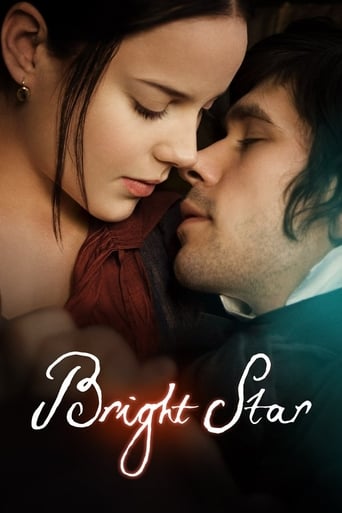
Bright Star (2009)
First love burns brightest.
In 1818, high-spirited young Fanny Brawne finds herself increasingly intrigued by the handsome but aloof poet John Keats, who lives next door to her family friends the Dilkes. After reading a book of his poetry, she finds herself even more drawn to the taciturn Keats. Although he agrees to teach her about poetry, Keats cannot act on his reciprocated feelings for Fanny, since as a struggling poet he has no money to support a wife.
- Date of release
- 2009-09-18
- TMDB
- 6.6 / 10 (499)
- Runtime
- 1h 59m
- Genres
- Drama, Romance
- Director
- Jane Campion
Casting
- Abbie Cornish — Fanny Brawne
- Ben Whishaw — John Keats
- Paul Schneider — Mr. Brown
- Kerry Fox — Mrs. Brawne
- Edie Martin — Toots
- Thomas Brodie-Sangster — Samuel
- Claudie Blakley — Maria Dilke
- Gerard Monaco — Charles Dilke
- Antonia Campbell-Hughes — Abigail
- Samuel Roukin — Reynolds
- Amanda Hale — Reynolds sister
- Lucinda Raikes — Reynolds sister
Interesting facts
- Box office: A$3.1M
- Filmed in: England
- Awards: 3 · Nominations: 11. Including: AACTA Award for Best Cinematography; AACTA Award for Best Costume Design; AACTA Award for Best Production Design
Bright Star is a 2009 biographical romantic drama film, written and directed by Jane Campion. It is based on the last three years of the life of poet John Keats and his romantic relationship with Fanny Brawne. Campion's screenplay was inspired by a 1997 biography of Keats by Andrew Motion, who served as a script consultant.
Production
In addition to "Bright Star" several other poems are recited in the film, including "La Belle Dame sans Merci" and "Ode to a Nightingale". Both Campion and Whishaw completed extensive research in preparation for the film. Many of the lines in the script are taken directly from Keats' letters. Whishaw, as well, learned how to write with a quill and ink during filming.
Janet Patterson, who has worked with Campion for over 20 years, served as both costume designer and production designer for the film.
The Hyde House and Estate in Hyde, Bedfordshire, substituted for the Keats House in Hampstead. Campion decided that the Keats House (also known as Wentworth Place) was too small and "a little bit fusty". Some filming also took place at Elstree Studios.
Composer Mark Bradshaw can be seen in the film as the conductor while the male choir performs the track Human Orchestra, which Bradshaw arranged from the third movement of the serenade for twelve winds and string bass by Wolfgang Amadeus Mozart.
Read on Wikipedia · Text from Wikipedia, CC BY-SA 4.0. Data from Wikidata.
Recommended
- The Last Letter from Your Lover 2021 · ★ 7.3
- Purple Hearts 2022 · ★ 8.0
- Dot the I 2003 · ★ 6.0
- Possession 2002 · ★ 6.0
- My Brilliant Career 1979 · ★ 6.2
- Anonymous 2011 · ★ 6.4
- All My Life 2020 · ★ 7.7
- The Man from Elysian Fields 2001 · ★ 5.9
- The Wings of the Dove 1997 · ★ 6.5
- Life in a Year 2020 · ★ 8.2
- The Portrait of a Lady 1996 · ★ 5.9
- The Secret: Dare to Dream 2020 · ★ 7.4