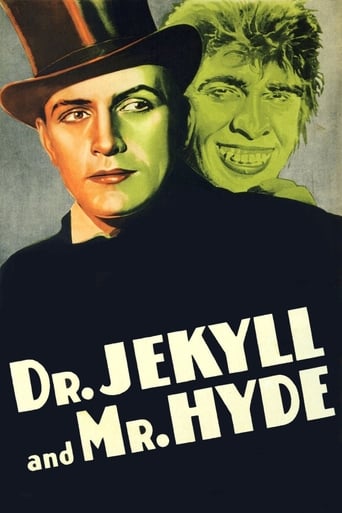
Dr. Jekyll and Mr. Hyde (1931)
Put yourself in her place! The dreaded night when her lover became a madman!
Dr. Henry Jekyll believes that there are two distinct sides to men: one that is good and one that is evil. He believes that by separating the two, man can become liberated. He succeeds in his experiments with chemicals to accomplish this and transforms into Hyde to commit horrendous crimes. When he discontinues use of the drug, it is already too late.
- Date of release
- 1931-12-24
- TMDB
- 7.2 / 10 (345)
- Runtime
- 1h 36m
- Genres
- Horror, Science Fiction, Drama
- Director
- Rouben Mamoulian
Casting
- Fredric March — Dr. Henry Jekyll / Mr. Edward Hyde
- Miriam Hopkins — Ivy Pearson
- Rose Hobart — Muriel Carew
- Holmes Herbert — Dr. John Lanyon
- Halliwell Hobbes — Brig. Gen. Sir Danvers Carew
- Edgar Norton — Poole
- Tempe Pigott — Mrs. Hawkins
- Leonard Carey — Briggs, Lanyon's Butler (uncredited)
- Sam Harris — Party Guest (uncredited)
- Boyd Irwin — Police Inspector (uncredited)
- Arnold Lucy — Utterson (uncredited)
- Murdock MacQuarrie — Dissenting Doctor at Lecture (uncredited)
Interesting facts
- Based on: Strange Case of Dr Jekyll and Mr Hyde
- Awards: 1 · Nominations: 3. Including: Academy Award for Best Actor
Dr. Jekyll and Mr. Hyde is a 1931 American pre-Code horror film, directed by Rouben Mamoulian and starring Fredric March, who plays a possessed doctor who tests his new formula that can unleash people's inner demons. The film is an adaptation of Strange Case of Dr. Jekyll and Mr. Hyde, the 1886 Robert Louis Stevenson tale of a man who takes a potion which turns him from a mild-mannered man of science into a homicidal maniac. The film was a critical and commercial success upon its release. Nominated for three Academy Awards, March won the award for Best Actor, sharing the award with Wallace Beery for The Champ.
Production
The film was made before the full enforcement of the Production Code, and it is remembered today for its strong sexual content, embodied mostly in the character of the bar singer Ivy Pierson, played by Miriam Hopkins. When it was re-released in 1936, the Code required 8 minutes to be removed before the film could be distributed to theaters. This footage was restored for the VHS and DVD releases.
The secret of the transformation scenes was not revealed for decades, when Mamoulian revealed it in The Celluloid Muse (1969), a volume of interviews with Hollywood directors. Make-up was applied in contrasting colors. A series of colored filters that matched the make-up was then used which enabled the make-up to be exposed gradually or made invisible. The change in color was not visible on the black-and-white film.
Wally Westmore's make-up for Hyde — simian and hairy with large canine teeth — greatly influenced the popular image of Hyde in media and comic books. In part, this look reflected the novella's implication of Hyde as embodying repressed evil, and hence being semi-evolved or simian in appearance.
John Barrymore was asked by Paramount to play the lead role in an attempt to recreate his role from the 1920 version of Jekyll and Hyde, but he was already under a new contract with Metro-Goldwyn-Mayer. Paramount suggested Irving Pichel for the role, but the director felt that while he would deliver a fine performance, he was not handsome enough and suggested March.
When Metro-Goldwyn-Mayer remade the film 10 years later with Spencer Tracy in the lead, the studio bought the negative and the rights to both the Mamoulian version and the earlier 1920 silent version, paying $125,000. Every print of the 1931 film that could be located was recalled and destroyed, and for decades, the film was believed lost.
Read on Wikipedia · Text from Wikipedia, CC BY-SA 4.0. Data from Wikidata.
Recommended
- Dr. Jekyll and Mr. Hyde 1941 · ★ 6.5
- Village of the Damned 1960 · ★ 7.2
- In the Blink of an Eye 2026 · ★ 5.9
- Stormageddon 2015 · ★ 6.0
- The Invisible Man 1933 · ★ 7.5
- Planet of the Apes 1968 · ★ 7.7
- Twice-Told Tales 1963 · ★ 6.2
- The Giver 2014 · ★ 6.6
- The Asphyx 1972 · ★ 6.0
- The Prestige 2006 · ★ 8.2
- Glass 2019 · ★ 6.7
- The Thing from Another World 1951 · ★ 6.7