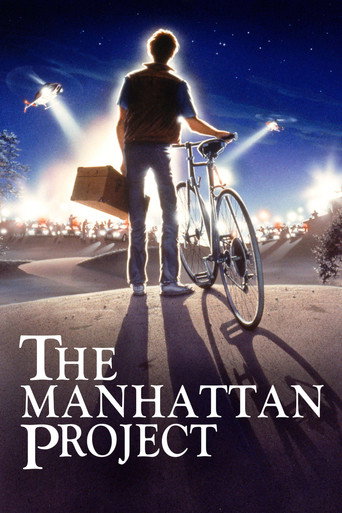
The Manhattan Project (1986)
Paul Stevens' high school science project has gotten a little out of hand. He just built an atomic bomb. Now he's got 11 hours to make sure it doesn't work.
A gifted high school student steals plutonium from the secret nuclear weapons facility in his home town in order to construct his own nuclear bomb, win a national science fair, and expose the government's secrets.
- Date of release
- 1986-06-13
- TMDB
- 6.2 / 10 (122)
- Runtime
- 1h 58m
- Genres
- Science Fiction, Thriller
- Director
- Marshall Brickman
Casting
- John Lithgow — John Mathewson
- Christopher Collet — Paul Stephens
- Cynthia Nixon — Jenny Anderman
- Jill Eikenberry — Elizabeth Stephens
- John Mahoney — Lt. Col. Conroy
- Richard Jenkins — Radiation Controls Officer
- Sully Boyar — Night Guard
- Timothy Carhart — Relief Guard
- Gregg Edelman — Science Teacher
- JD Cullum — Eccles (as John David Cullum)
- Abraham Unger — Roland (as Abe Unger)
- Robert Sean Leonard — Max
Interesting facts
- Filmed in: New York City and New Jersey
- Awards: 1 · Nominations: 0. Including: The President's Memorial Award
The Manhattan Project is a 1986 American science fiction thriller film. Named after the World War II-era program that constructed the first atomic bombs, the plot revolves around a gifted high school student who decides to construct an atomic bomb for a national science fair. It was directed by Marshall Brickman, based upon his screenplay co-written with Thomas Baum, and starred Christopher Collet, John Lithgow, John Mahoney, Jill Eikenberry and Cynthia Nixon. This film – a box-office bomb whose ticket sales recovered just 21 percent of its budget – was the first from the short-lived Gladden Entertainment.
Production
After making Lovesick, Brickman was interested in doing something other than comedy.
"Jokes are easy," he said. "Humor comes to me so easily I'm suspicious of it. I secrete jokes like the pancreas secretes...whatever the pancreas secretes. I wanted character, I wanted to go for the emotions that the kid feels, that the scientist feels; I wanted the audience to feel the seductiveness of machinery."
He chose the Manhattan Project. However he decided against doing something historical because "It's such a monster to do, the scope is so enormous – I couldn't come up with a viable way to make it that wouldn't cost under $60 million to produce." He instead decided to do something in a contemporary setting which dealt with the same themes.
"I became fascinated with the two worlds that coexist in America now," he says. "The one world of ordinary citizens, like the kid in the movie who has all the concommitant problems of adolescence – sex and girls and school and then the other world, which is the world of the military–industrial complex, and within that world the sort of high-priesthood of nuclear-weapons planners and designers.
He also thought "it might be a good idea to approach the bomb as another consumer item, which in a sense it is. You know, it provides a lot of jobs, a lot of work, and ironically a lot of good side-effects."
Read on Wikipedia · Text from Wikipedia, CC BY-SA 4.0. Data from Wikidata.
Recommended
- The Invisible Man 1933 · ★ 7.5
- Disclosure Day 2026 · ★ 7.4
- I Am Number Four 2011 · ★ 6.2
- The Saint 1997 · ★ 6.1
- WarGames 1983 · ★ 7.1
- The Andromeda Strain 1971 · ★ 7.0
- The Asphyx 1972 · ★ 6.0
- The Amazing Spider-Man 2 2014 · ★ 6.6
- The Adventures of Buckaroo Banzai Across the 8th Dimension 1984 · ★ 6.0
- Alien Abduction 2014 · ★ 5.9
- Gemini Man 2019 · ★ 6.2
- 2073 2024 · ★ 6.8