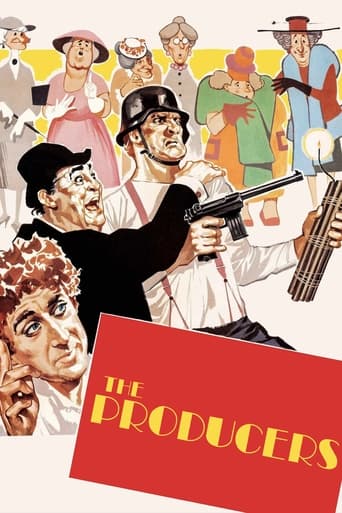
The Producers (1968)
Hollywood Never Faced a Zanier Zero Hour!
A conniving Broadway producer and his meek accountant plan to profit from charming wealthy old biddies to invest in an overbudget production, and then put on a sure-fire disaster, so nobody will ask for their money back — and what's more disastrous than a tasteless musical celebrating Adolf Hitler.
- Date of release
- 1968-03-18
- TMDB
- 7.1 / 10 (964)
- Runtime
- 1h 29m
- Genres
- Comedy
- Director
- Mel Brooks
Casting
- Zero Mostel — Max Bialystock
- Gene Wilder — Leo Bloom
- Dick Shawn — Lorenzo St. DuBois (L.S.D.)
- Kenneth Mars — Franz Liebkind
- Estelle Winwood — "Hold Me Touch Me"
- Christopher Hewett — Roger De Bris
- Andréas Voutsinas — Carmen Ghia
- Lee Meredith — Ulla
- Renée Taylor — Eva Braun
- Michael Davis — Production Tenor
- John Zoller — Drama Critic
- Madlyn Cates — Concierge
Interesting facts
- Box office: $1.6M
- Budget: $941K
- Earned 1.7× its budget
- Filmed in: New York City
- Awards: 2 · Nominations: 2. Including: Academy Award for Best Writing, Original Screenplay; Writers Guild of America Award for Best Original Screenplay
The Producers is a 1967 American satirical black comedy film written and directed by Mel Brooks, and starring Gene Wilder, Zero Mostel, Dick Shawn, and Kenneth Mars. The film is about a mild-mannered accountant and a con artist theater producer who scheme to get rich by fraudulently overselling shares in a stage musical designed to fail. To this end, they find a playscript celebrating Adolf Hitler and the Nazis and bring it to the stage. Because of this theme, The Producers was controversial from the start and received mixed reviews. It became a cult film, and found a positive critical reception later.
Production
A substantive early New York Times account of the property's genesis dates to December 1961: "Edward Padula has acquired a new comedy by Mel Brooks tentatively called 'Springtime for Hitler'. The producer said yesterday that actually 'Hitler is not in the comedy.' 'It's a sort of play-within-a-play. The setting is contemporary England.' Kenneth Williams, rated by Mr.
The title Springtime for Hitler was first coined by Brooks as a joke during the press conference for All American in 1962. Shortly afterwards, he also decided to relate this title to a character named Leo Bloom, an homage to Leopold Bloom, protagonist of James Joyce's Ulysses. It was reused by him years later once he had an idea about "two schnooks on Broadway who set out to produce a flop and swindle the backers".
More than anything the great Holocaust by the Nazis is probably the great outrage of the 20th century. There is nothing to compare with it. And ... so what can I do about it? If I get on the soapbox and wax eloquently, it'll be blown away in the wind, but if I do Springtime for Hitler it'll never be forgotten. I think you can bring down totalitarian governments faster by using ridicule than you can with invective.
Brooks first envisioned his story as a novel, and changed it to a play when publishers told him it had "too much dialogue. Not enough narrative". He wrote the script in nine months, with the help of secretary Alfa-Betty Olsen. During the process, he mentioned in an October 1966 interview with Playboy that he was working on Springtime for Hitler, "a play within a play, or a play within a film – I haven't decided yet".
As Brooks sought backers for his 30-page film treatment, both major film studios and independent filmmakers rejected Springtime for Hitler, finding the idea of using Hitler for comedy outrageous and tasteless (with some even stating that they would consider the script if Brooks changed it to Springtime for Mussolini). This changed as Brooks's agent arranged for him to have a meeting with a friend of his, New York producer Sidney Glazier.
Read on Wikipedia · Text from Wikipedia, CC BY-SA 4.0. Data from Wikidata.
Recommended
- The Producers 2005 · ★ 6.2
- Oscar 1991 · ★ 6.4
- Yankee Zulu 1993 · ★ 6.2
- Tower Heist 2011 · ★ 6.1
- Brain Donors 1992 · ★ 6.1
- Brewster's Millions 1985 · ★ 6.6
- The Distinguished Gentleman 1992 · ★ 6.0
- The Honey Pot 1967 · ★ 6.5
- The Hustle 2019 · ★ 6.2
- The Cocoanuts 1929 · ★ 6.5
- Boeing, Boeing 1965 · ★ 6.4
- Bandits 2001 · ★ 6.3