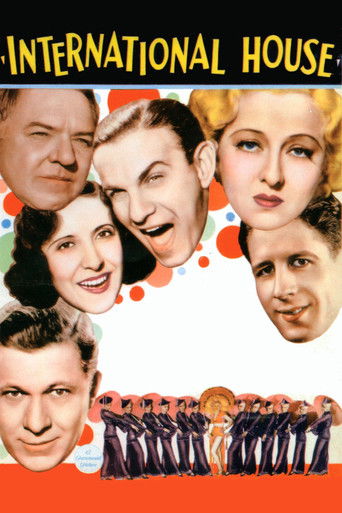
International House (1933)
Foreign investors converge on a luxury hotel in China to bid on a new kind of radioscope. But, this is a hotel where Burns and Allen are the in-house medical staff, a measles risk sends the whole building into quarantine, and a madcap millionaire crashes dinner in his autogyro. Hotel and radioscope become a stage for an all-star cast of comedians and musicians, from vaudeville to the new generation.
- Erscheinungsdatum
- 1933-05-27
- TMDB
- 5.7 / 10 (23)
- Laufzeit
- 1 Std. 8 Min.
- Genres
- Komödie
- Regie
- A. Edward Sutherland
Besetzung
- Peggy Hopkins Joyce — Peggy Hopkins Joyce
- W.C. Fields — Professor Quail
- Rudy Vallee — Himself
- Stuart Erwin — Tommy Nash
- George Burns — Doctor Burns
- Gracie Allen — Nurse Allen
- Sari Maritza — Carol Fortescue
- F. Chase Taylor — Colonel Stoopnagle
- Budd Hulick — Budd
- Cab Calloway — Cab Calloway
- Bela Lugosi — General Petronovich
- Rose Marie — Herself / Baby Rose Marie
Wissenswertes
International House is a 1933 American pre-Code comedy film starring Peggy Hopkins Joyce and W. C. Fields, directed by A. Edward Sutherland and released by Paramount Pictures. The tagline of the film was "The Grand Hotel of comedy". It is a mixture of comedy and musical acts tied together by a slim plot line, in the style of the Big Broadcast pictures that were also released by Paramount during the 1930s. In addition to some typical comedic lunacy from W. C. Fields and Burns and Allen, it provides a snapshot of some popular stage and radio acts of the era. The film includes some risqué pre-Code humor.
Production
International House was produced before a strict Hollywood Production Code took effect in July 1934, and it is notable for the kind of risqué subject matter, humor and costumes associated with Pre-Code Hollywood. Top-billed Peggy Hopkins Joyce was famous as an unabashed real-life gold-digger, not as an actress.
The setting of Wuhu, China also serves as a play on "Woo-hoo!", an exclamation which at that time was sometimes used to comment that something was sexually naughty. Hearing the city's name, W. C. Fields, as Professor Quail, responds to what he mistakes as homosexual flirting with "Don't let the posy fool you", referring to his own boutonniere, which he plucks out and tosses away.
Performing with his hot dance band, Cab Calloway sings "Reefer Man", which describes the odd behavior and ravings of the titular heavy marijuana smoker (portrayed by bass player Al Morgan, who performs as if in a trance). In one gag, W. C.
W. C. Fields took a dim view of such censorship and took a potshot at Hollywood censor Will Hays. In the sequence with the Austin – the smallest car sold in America at that time – Fields remarks that it "used to belong to the Postmaster General." The diminutive Hays was a former Postmaster General.
Fields also saw an opportunity to add black comedy to Rudy Vallee's song sequence: he proposed that his character Quail should aim a gun at Vallee's televised performance and shoot him, with Vallee falling dead. Vallee objected to the gag. In the finished film, Quail aims the gun and fires, but misses his target: we see a ship sinking.
Auf Wikipedia weiterlesen · Text aus Wikipedia, CC BY-SA 4.0. Daten aus Wikidata.
Empfohlen
- The Cocoanuts 1929 · ★ 6.5
- Die Marx Brothers - Zimmerdienst 1938 · ★ 6.5
- Hallo, Page! 1960 · ★ 6.2
- Musik ist unsere Welt 1939 · ★ 6.4
- Parade im Rampenlicht 1933 · ★ 6.8
- Kevin Hart: I'm a Grown Little Man 2009 · ★ 7.3
- Buddy Buddy 1981 · ★ 6.1
- Die zwölf Stühle 1970 · ★ 6.2
- Die Maus, die brüllte 1959 · ★ 6.4
- Computer Chess 2013 · ★ 6.1
- Die tollkühne Rettung der Gangsterbraut Honey Swanson 1948 · ★ 6.5
- Robots 2005 · ★ 6.5